Most blog content never gets cited by AI search engines because it's missing three specific patterns: the content capsule technique, source-backed claims, and strategic internal linking. I built a Claude Code skill that applies all three automatically, and you can build one too (or download mine for free).
Why Does Most Blog Content Never Get Cited by AI Search Engines?
Because it's written the old way. Getting picked up by Google AI Overviews, ChatGPT, and Perplexity requires three specific strategies that most content creators are completely missing.
The shift is real: AI-referred website sessions grew 527% in the first half of 2025, and AI search visitors convert 4.4x better than organic search visitors. But there's a catch. AI search engines only cite 2 to 7 domains per response. You're either in that shortlist or you're invisible.
The three techniques that get you on that shortlist:
- The Content Capsule Technique (used by 72% of ChatGPT-cited pages)
- Source-Backed Claims (115% increase in AI visibility)
- Strategic Internal Linking (builds topical authority across your site)
I built a Claude Code skill that applies all three to every blog post it writes. Let me walk you through each technique, then show you the skill in action.
What Is the Content Capsule Technique and Why Does It Work?
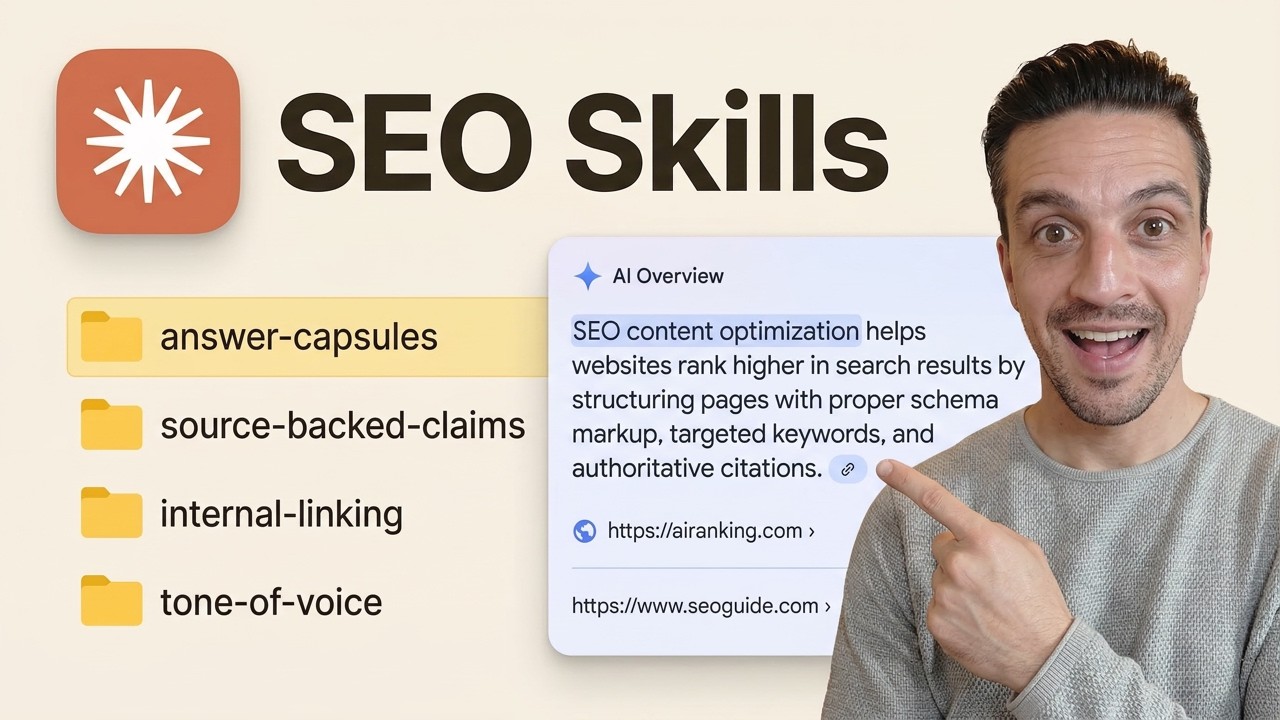
It's a writing pattern where every H2 heading is phrased as a question, followed immediately by a 30 to 60 word paragraph that answers it directly. If someone reads just that one section and nothing else, it should make complete sense on its own.
According to a Search Engine Land study of 8,000 AI citations, 72% of pages cited by ChatGPT use this answer capsule structure. Pages with these capsule-style introductions see a 40% higher citation rate compared to pages that bury the answer under a wall of text.
Here's why it works: AI search engines crawl your content looking for extractable, direct answers. When your H2 says "What is AI SEO?" and the next sentence says "AI SEO is the practice of optimizing your content so that it appears in AI search results as citations or mentions," that's exactly what the AI can grab, format, and cite in its response.
No "in the ever-evolving world of digital marketing..." preamble. No throat-clearing. Just the answer, right away.
Important: you don't want 100% of your blog post written this way. That would read like a giant FAQ. Aim for about 50 to 60% content capsule technique, and leave room for your experience, your editorial voice, and your stories in between.
How Do Source-Backed Claims Increase AI Visibility?
By linking your statements to credible research. Studies show websites citing credible sources see an average 115% increase in AI visibility compared to content making unsupported claims.
AI search engines need to trust the content they cite. When your blog post makes a claim and that claim hyperlinks to a respected source (think Semrush, Gartner, Search Engine Land), the AI can verify your statement and feels confident including your page in its response.
Here's the key detail most people miss: you need to link the contextual keyword, not dump all your sources in a "References" section at the bottom. This isn't a university essay.
For example, instead of writing:
"72% of cited pages use answer capsules (Source: Search Engine Land, 2024)"
You write:
"According to a Search Engine Land study of 8,000 AI citations, 72% of cited pages use answer capsules."
The link is woven into the sentence naturally. The reader can click through if they want, and the AI crawler sees that your claim is backed by a high-authority domain.
How often should you cite sources? Every time you make a factual claim. If you want a rough number, aim for a source every 150 to 200 words throughout the post. Not all sources carry equal weight though. Prioritize linking to well-known industry publications, research reports, and original data studies.
Why Is Strategic Internal Linking So Important for AI Search?
Because a blog post without internal links is like a room in a house with no doors. It sits alone, disconnected from everything else on your site.
Internal linking does three things for AI search optimization:
- Builds topical authority. When you link between related posts, search engines (both traditional and AI) understand that your site has deep expertise on that topic. Brands publishing proprietary data and building topical clusters see 45% more citations.
- Increases crawlability. Internal links help AI crawlers discover and index your content faster. If a page is linked from five other pages, it's going to get crawled more frequently than an orphan page with zero links pointing to it.
- Improves conversions. Visitors who click through to related content stay longer and are more likely to join your community, sign up for your email list, or become a customer.
The rules are simple. Link to pages that genuinely relate to the topic at hand. Don't force links to unrelated pages just because you want more traffic on them. Use descriptive anchor text (the keyword phrase, not "click here"). And make sure every blog post links to at least 2 to 3 other pages on your site.
William Moon, a financial advisor in our AI Ranking community, increased his CTR from 0.3% to 2.3% after implementing these three techniques across his blog. That jump in visibility led to a $165,000 client deal directly from organic and AI search traffic.
How Does a Claude Code Skill Automate All Three Techniques?
A Claude Code skill is a reusable instruction file that tells Claude exactly how to write your content, including which techniques to apply, what tone to use, and how to format everything.
If you're unfamiliar with Claude Code skills, think of them as a recipe card. Instead of explaining how you want your blog posts written every single time, you write the instructions once and Claude follows them automatically on every post.
My SEO copywriter skill handles all three techniques in one pass:
- Content capsule technique: Every H2 is a question, every section opens with a direct answer
- Source-backed claims: Claude researches and links to credible sources throughout the post
- Internal linking: Claude reads your existing blog posts and links to relevant ones naturally
When I tested the skill with a prompt like "write a blog post about Claude Code scheduled tasks," it produced a fully structured post with the TL;DR section, question-based headings with capsule answers, external sources linked to contextual keywords, and internal links to my existing content. All three techniques, applied automatically.
The best part? The skill adapts to your CLAUDE.md memory file, so it already knows your brand voice, your website structure, and your content strategy. No re-explaining every session.
How Can You Get This Skill for Your Own Content?
Two options, both free.
Option 1: Download the pre-built skill. If you're inside the AI Ranking community, there's a dedicated Claude Code Skills section in the classroom. Download the SEO copywriter skill file, go to your Claude account, click "Customize" in the left sidebar, create a new skill, and upload the file. Done.
Option 2: Build your own from a prompt. If you're not in the community, I've shared a Google Doc prompt that will generate this skill for you. You'll need to fill in a few details about your website and tone of voice, but the prompt handles the rest. The output is a complete skill file you can upload to Claude.
Either way, once the skill is installed, you just tell Claude to use it: "Use the SEO writer skill and write a blog post about [topic]." Claude handles the structure, the sources, and the internal links. You review, add your personal touches, and publish.
Frequently Asked Questions
Does the content capsule technique work for all types of blog posts?
It works best for informational and educational content where the reader has a specific question. For pure opinion pieces or personal stories, you'll want more editorial flow and less rigid Q&A structure. Aim for 50 to 60% capsule technique across your posts.
How many internal links should a blog post have?
There's no magic number, but aim for at least 2 to 3 internal links per post. Longer posts (2,000+ words) can comfortably include 5 to 8 internal links without feeling forced. The key is relevance: every link should genuinely help the reader understand a related topic.
Can I use this skill with tools other than Claude?
The three techniques (content capsules, source-backed claims, internal linking) work with any AI writing tool. The specific skill file is designed for Claude Code, but you can adapt the instructions into a custom GPT, a Gemini prompt, or any other AI assistant.
How long does it take to see results from these techniques?
Most people see their first AI citations within 4 to 8 weeks of publishing optimized content. Sarah M., an agency owner in the AI Ranking community, got cited by ChatGPT within 3 weeks and saw her AI search traffic increase by 200%.
Ready to Get Your Content Cited by AI Search?
These three techniques are not complicated. The content capsule technique, source-backed claims, and strategic internal linking are simple patterns that any content creator can implement today.
If you want the done-for-you version, join the AI Ranking community and download the Claude Code skill directly. You'll also get an onboarding call, weekly Q&A sessions, and access to the full course library.
Not ready to join? No worries. Grab the free prompt from the video description and build your own skill. Either way, start applying these three patterns to your next blog post. Your future AI citations will thank you.
Resources
- The Capsule Content Method: How to Get Cited by AI
- How to Write Content That Ranks in AI Search
- SEO, AEO, and GEO: The Complete Guide
- How to Get Found in AI Search
- Claude Code Memory for Marketing and SEO
- Search Engine Land: 8,000 AI Citations Study
- Surfer SEO: AI Citation Report
- Semrush: AI Search SEO Traffic Study
- Seer Interactive: ChatGPT Conversion Study
- AI Ranking Community on Skool