Does Google Penalize AI Content? The 2026 Facts
Google does not penalize AI content. What gets penalized is lazy, low-quality content, regardless of who or what wrote it. Here are the 2026 facts, real community results, and the simple workflow that makes AI content rank.

Does Google Actually Penalize AI Content?
No. Google does not penalize content for being written by AI. Google penalizes content that is low-quality, unhelpful, or created purely to manipulate search rankings. The method of creation (human or AI) is irrelevant. What matters is whether your content answers the searcher's question, brings something new to the table, and demonstrates real experience. That is Google's official position, and that is what we see playing out in practice every single day.
If you have been holding back from using AI to write content because you are afraid of a penalty, you are leaving traffic (and money) on the table for no reason.
What Google Actually Said
In February 2023, Google published an official blog post titled "Google Search's guidance about AI-generated content." The message was clear:
"Our focus on the quality of content, rather than how content is produced, is a useful guide that has helped us deliver reliable, high quality results to users for years."
Google's spam policies target content created "with the primary purpose of manipulating ranking in search results." That applies to human-written content just as much as AI-written content.
John Mueller reinforced this in November 2025: "Our systems don't care if content is created by AI or humans. We care if it's helpful, accurate, and created to serve users rather than just manipulate search rankings."
The Helpful Content System, now baked directly into Google's core ranking algorithm, evaluates whether content is genuinely useful. It does not run an AI detector on your blog posts.
The Real Problem: Lazy Content, Not AI Content
Here is what actually gets penalized:
- Scaled content abuse: Publishing hundreds of thin, templated pages with no original insight. Google started issuing manual actions for this in June 2025.
- Zero value-add: Taking raw AI output and hitting publish without adding experience, editing for accuracy, or answering the search intent better than what already exists.
- Keyword stuffing disguised as AI content: Using AI to generate walls of text stuffed with keywords but saying nothing useful.
None of these are AI-specific problems. People were doing all of this with human writers and content farms long before ChatGPT existed. Google has always penalized low-quality content. AI just made it faster to produce.
Stop Wasting Time on AI Content Detectors
This is where most people get it wrong. They spend hours running their content through AI detection tools, rewriting sentences to "sound more human," and stressing over detection scores.
AI content detectors are unreliable. They produce false positives constantly, flagging human-written content as AI and missing obvious AI content. Google has never confirmed using AI detection as a ranking signal. And why would they? Their entire position is that the method of creation does not matter.
The time you spend trying to fool a detector is time you could spend making your content actually better. Add a real example from your experience. Include a data point nobody else mentions. Answer a follow-up question your competitors ignore.
That is what moves rankings. Not a detection score.
What Actually Makes AI Content Rank
After working with hundreds of business owners in our AI Ranking community, the pattern is clear. AI content ranks when it does three things:
- Answers the search intent directly. Not in paragraph five. In the first sentence after the heading.
- Includes real experience. A case study, a personal result, a client story. Something an AI model could not have invented on its own.
- Brings something new. If your AI-written article says the same thing as the top 10 results, why would Google rank it? You need an original angle, fresh data, or a perspective the other results are missing.
It does not matter whether you write it with Claude, ChatGPT, Gemini, or any other tool. The AI is the vehicle. The value is what you bring to it.
The Simple Workflow That Works
You do not need a complicated process. You need three documents and a clear set of instructions:
1. A Tone of Voice Document
Write down how you communicate. Are you casual or formal? Do you use analogies? What words do you never use? This keeps your AI output consistent across every piece of content.
2. An Experience Document
This is the most important piece. Dump everything you know about your topic into one document: client results, personal stories, lessons learned, data you have collected, opinions you hold strongly. The more specific, the better.
3. A Set of Writing Instructions
Tell the AI to read both documents before writing. Tell it to weave in experience naturally, match your tone, and use the content capsule technique (a 40-70 word direct answer right after each heading). This gives you the highest chance of ranking in both traditional search and AI search results.
You can set this up in Claude Projects, a custom GPT, Claude Code, or any AI workspace that supports persistent context. The tool does not matter. The system does.
Bonus: Record a video first. If you film a YouTube video on the topic and then write the blog post around it (embedding the video), you get two pieces of content that reinforce each other. Blog posts with embedded YouTube videos get selected for AI Overviews 156% more often.
Proof: Community Members Ranking with AI Content
This is not theory. These are real results from people in our community using AI-written content.
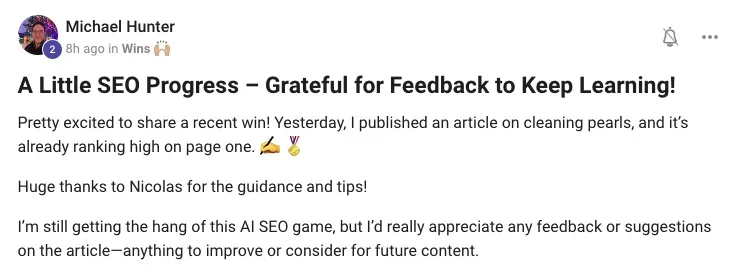
Michael Hunter: Page One Rankings Overnight
Michael published an AI-written article about cleaning pearls. The next day, it was ranking on page one of Google. No manual rewriting to "remove AI traces." No running it through detectors. He focused on making the content genuinely helpful for someone searching that topic, and Google rewarded it immediately.
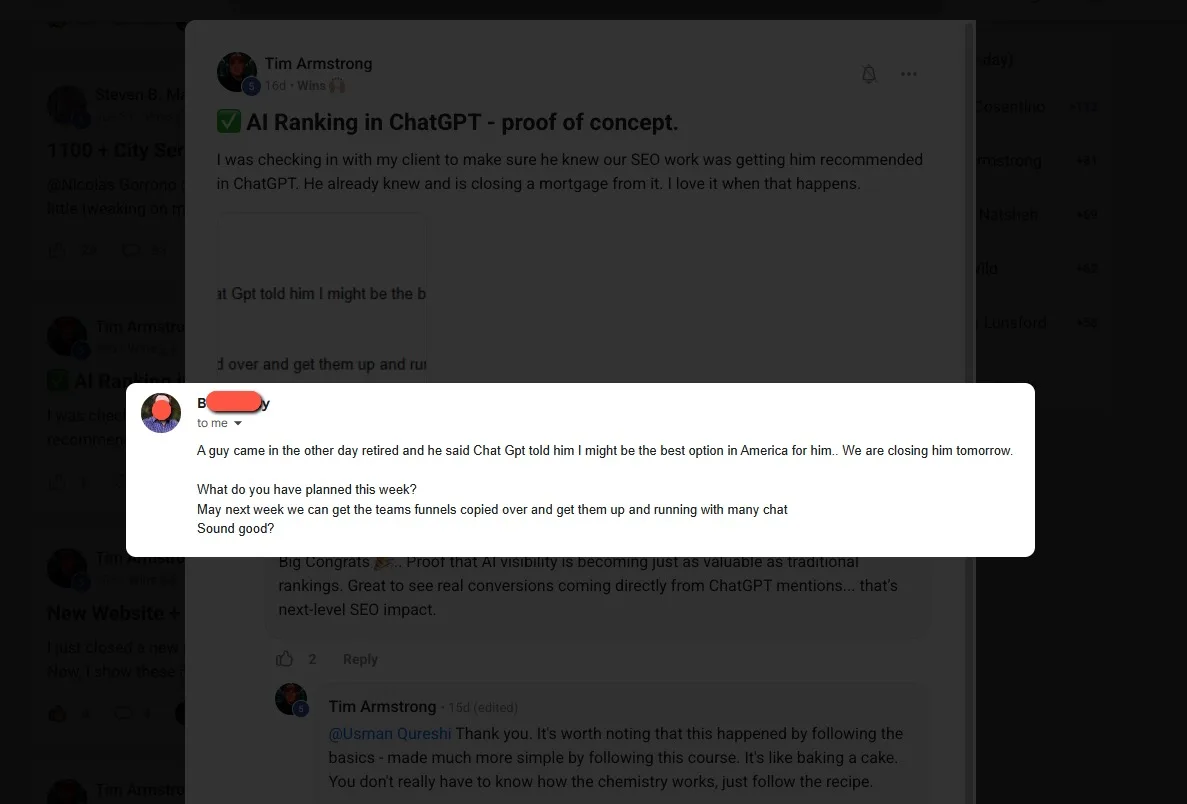
Tim Armstrong: Closing Deals from ChatGPT Recommendations
Tim's client is not just ranking in Google. ChatGPT is actively recommending his client's business. One retired customer walked in and said, "ChatGPT told me you might be the best option in America for this." They closed that deal.
This is the new reality. When you create genuinely helpful, experience-rich content (regardless of whether AI helped write it), you do not just rank in Google. You get cited in AI search tools like ChatGPT, Perplexity, and Gemini. That is where search is heading, and it makes the "does Google penalize AI content?" question almost quaint.
What the Data Shows
A 2025 study by Rankability analyzed 487 top Google search results and found that 83% scored as "original" (non-AI) content. Some people use this to argue Google prefers human content. But that misses the point.
Most AI content published today is low-effort, unedited output. The 17% of AI content that does rank is the content where someone added genuine value on top of the AI draft. That is the gap you should be exploiting: most of your competitors are either avoiding AI entirely (leaving speed on the table) or using AI lazily (leaving quality on the table). Do both well and you win.
The Google Quality Rater Guidelines Update
In early 2025, Google updated its Search Quality Rater Guidelines with specific instructions about AI content. Quality raters (the humans who evaluate search results to train Google's algorithms) are now told to flag AI content that adds no original value, insight, or expertise with the "lowest" rating.
But the guidelines also make clear: AI-assisted content that demonstrates E-E-A-T (Experience, Expertise, Authoritativeness, Trustworthiness) is perfectly acceptable. The first "E" (Experience) is key. That is the one thing AI cannot fake on its own. You have to bring it.
The Bottom Line
Google does not care how you write your content. Google cares whether your content deserves to rank.
Use AI to write faster. Use your experience to write better. Combine the two with a simple system (tone of voice, experience document, clear instructions) and you will outperform both the people avoiding AI and the people using it lazily.
Stop worrying about detectors. Start creating content that actually helps people. That is what ranks in 2026.
Frequently Asked Questions
Does Google penalize AI-generated content?
No. Google's official policy states they reward helpful, people-first content regardless of how it is produced. Content gets penalized for being low-quality or manipulative, not for being AI-generated.
Can Google detect AI-written content?
Google has not confirmed using AI detection in their ranking algorithms. Their focus is on content quality signals like E-E-A-T (Experience, Expertise, Authoritativeness, Trustworthiness), not on detecting the method of creation.
Should I use AI content detectors before publishing?
No. AI content detectors are unreliable and produce frequent false positives. Your time is better spent improving the content itself: adding personal experience, unique data, and genuinely answering the search intent.
What is scaled content abuse?
Scaled content abuse is when websites mass-produce low-quality content (often with AI) purely to manipulate search rankings. Google began issuing manual actions for this in June 2025. The issue is the low quality and manipulative intent, not the use of AI.
How do I make AI content rank in Google?
Focus on three things: answer the search intent directly, include real experience and original insights, and bring something new that competitors are not covering. Use a tone of voice document and an experience document to guide your AI tool.
Does AI content rank in ChatGPT and Perplexity too?
Yes. Helpful, experience-rich content gets cited across AI search tools. Community members have reported being directly recommended by ChatGPT to potential customers, leading to closed deals.