
What a year.
If you've been anywhere near SEO or AI this year, you've probably felt like you're drinking from a firehose. New models dropping every other week. Google AI Overviews everywhere. ChatGPT launching search. Perplexity becoming a thing. And about 47 new acronyms to learn (GEO, LLMSEO, AISEO... I could go on).
I've spent 2025 deep in the trenches with our AI Ranking community, testing, breaking things, and figuring out what actually works. Here's what I learned.
1. SEO Is Still SEO (Just in a Fancier Outfit)
Let's get this one out of the way first.
There's been a lot of noise about "GEO" (Generative Engine Optimization) and "LLMSEO" and "AISEO" and whatever other acronym someone's trying to trademark this week. And look, I get it—new things need new names. But here's what I keep seeing over and over again:
It's all still SEO.
People love repackaging the same thing in shiny new wrapping paper. Don't get me wrong, a lot has changed. But the fundamentals? Still the fundamentals.
You still need solid on-site SEO. You still need proper schema markup. You still need to put the right keywords in the right places—title tags, H1s, H2s, the usual suspects.
We see this constantly with our community members. They come in asking about GEO and AISEO, all excited about the new stuff. But as soon as we show them how to nail the basics of good SEO? That's when the results actually start rolling in—traffic increases, leads from AI search, the works.
So before you chase the shiny new thing, ask yourself: are my basics actually dialled in?
2. SEO Has Evolved Beyond Websites
Here's where things have genuinely shifted.
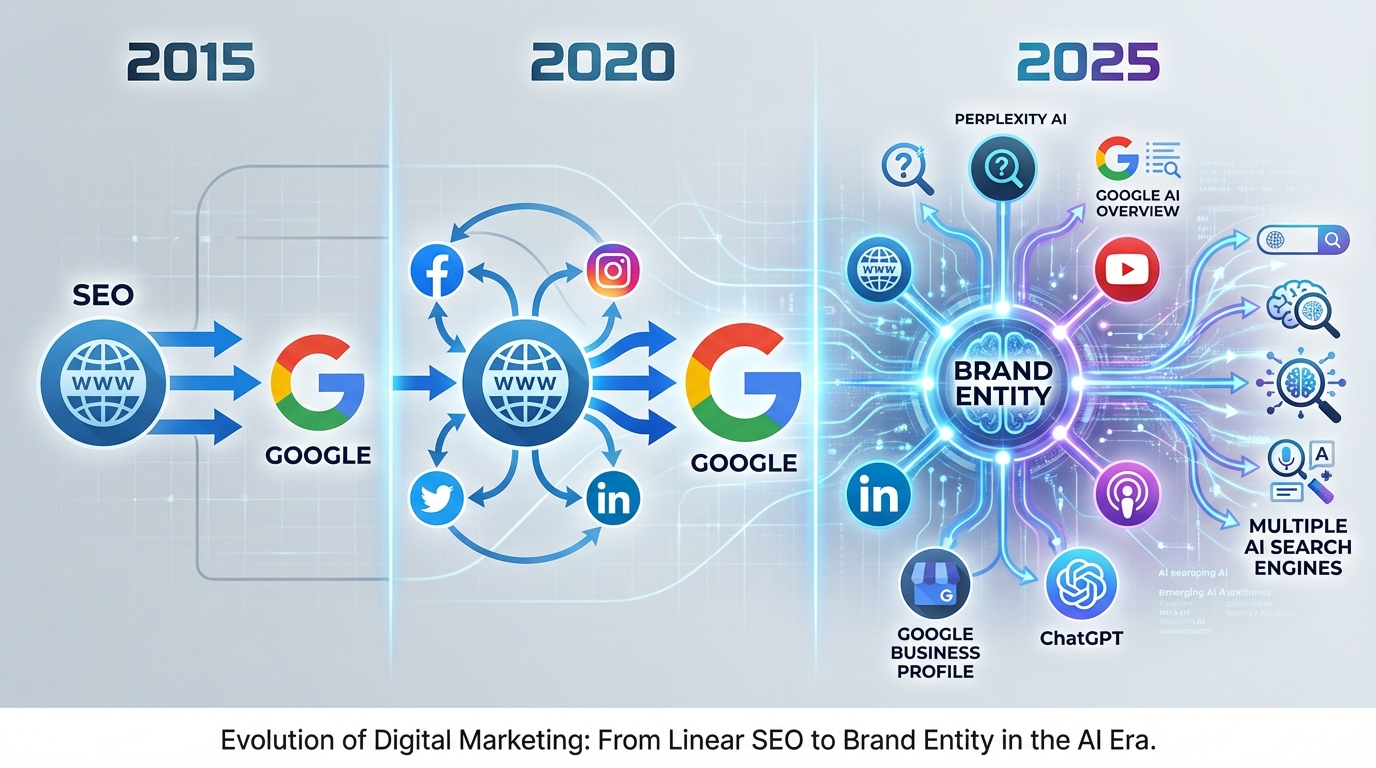
SEO isn't just about your website anymore. It's about building authority across the entire internet—and that includes social media.
Why? Because AI search engines are paranoid about being wrong. They're constantly trying to limit mistakes, and one of the main ways they do that is by only citing sources they trust. They want reputable, verifiable sources.
So how do you become one of those sources?
You stop thinking of your business as just a website and start treating it as an entity. A brand that exists everywhere online. Your website, yes—but also your LinkedIn, your YouTube, your podcast appearances, your guest posts, your Google Business Profile, your citations across the web.
The more places you show up consistently, the more believable and trustworthy you become. And that's exactly what the AI needs to feel confident citing you.
3. The Way We Measure Success Is Changing
If you're still obsessing over traditional traffic metrics, I've got some news that might sting a bit.
We're all getting less traffic. That's just the new reality.
AI Overviews are answering queries directly. People are getting answers in ChatGPT and Perplexity without ever clicking through. Zero-click searches are through the roof.
This is going to fundamentally shift the advertising industry. I wouldn't start a how-to blog or recipe site hoping to make money from AdSense—let's put it that way.
But here's the flip side (and it's a good one):
The traffic you do get is converting at insane rates. According to Ahrefs, AI search visitors convert at 23x higher rates than traditional organic traffic. Seer Interactive found ChatGPT traffic converting at 15.9% compared to 1.76% for Google organic.
Less traffic, but way more valuable traffic.
So the question becomes: how do you get more of that high-intent traffic?
4. Transactional Pages Are Your Secret Weapon
The answer to that question? More transactional pages.
Here's what I mean:
Every single service you offer should have its own dedicated page. Don't lump all your services onto one page—they'll compete with each other and make it easier for competitors to outrank you.
Let me give you an example.
Say you're Jim's Plumbing, competing against Bob's Plumbing. You check out Bob's website and see he offers three main services: 24-hour emergency plumbing, hot water installation, and pipe leak repair. He probably offers more, but those are the only ones on his "Services" page.
Here's how you beat Bob from an on-site SEO perspective:
At the very least, create a dedicated page for each of those services. This allows AI search engines to deliver the exact right page when someone searches for that specific service. Instead of one generic services page competing for everything, you've got targeted pages competing for exactly what people are searching for.
Now, there's a lot more that goes into ranking well. But this one? This one always works.
5. Location Pages Still Crush It
One thing that surprised me this year: creating hundreds of location pages with individual service pages still works to outrank competitors. Every. Single. Time.
Case in point: one of our community members, Steven, created over 800 service/location pages for a client. The result? 105 online appointments in a single month—breaking their previous record of 99. And the pages were indexing within an hour of submission.
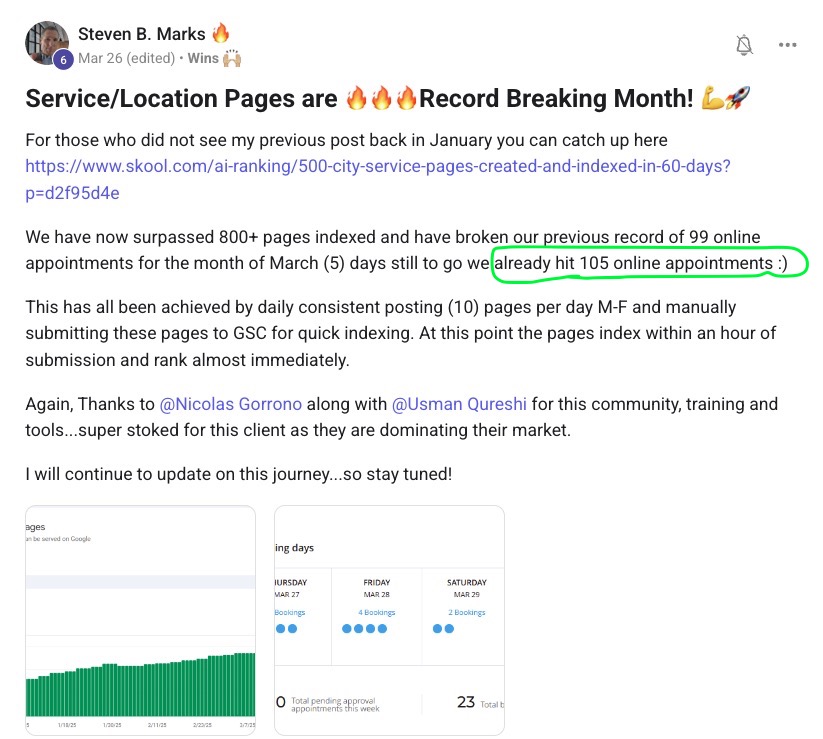
His approach was simple but consistent: 10 pages per day, Monday to Friday, manually submitted to Google Search Console for quick indexing. No magic. Just volume + consistency + proper on-site SEO.
The key is getting them indexed gradually—don't dump 500 pages on Google overnight. But if you do it right, it's almost unfair how well it works.
(If you're a local business and you're not doing this, we need to talk.)
6. Stop Chasing the Newest Model
GPT-5.2, Gemini 3. Claude Opus 4. The next thing. And the next thing after that.
Here's a truth bomb: for most people doing regular work—marketing, emails, content—all the flagship models are smart enough.
You don't need to jump on every new release hoping your emails will somehow sound 10% better. They won't. Chasing the smartest model will give you serious FOMO that keeps you up at night and ruins your time off. Trust me, I know.
Here's what actually works:
Learn one ecosystem really well. Let's say you've gotten good with OpenAI. Great—make that your main workspace. Don't be afraid to try other models when they release something interesting, but don't jump ship to Google just because their image generation is slightly better this week.
OpenAI will catch up. Google will catch up. They all catch up.
Pick your horse and ride it. Dabble with the others. But don't let FOMO run your life.
7. Agents Will Replace Automations
Sorry, Make. Sorry, n8n. I love you both, but I think your days are numbered.
Automation platforms are incredible for connecting apps and running workflows. But AI agents can do all of that and make decisions on the fly. They can handle edge cases. They can adapt.
Right now, agents are still a bit clunky to set up. But give it another year or two and I think we'll look back at traditional automation platforms the way we look at manually doing things in spreadsheets.
This is where I'm personally spending a lot of my learning time heading into 2026.
8. Find Your People
The last thing I learned—and maybe the most important—is the value of having people around you who geek out on this stuff as much as you do.
Why?
Because one person alone can never try all the models, all the tools, all the strategies. There's just too much happening too fast.
Having people around you who are just as interested as you are keeps you in the best position possible. You learn from their experiments. They learn from yours. Someone figures out a trick with Claude, someone else cracks the code on AI Overviews, someone else finds a workflow that saves 10 hours a week.
It's why I built the AI Ranking community. Not to lecture people, but to learn alongside them. And honestly, I've learned just as much from our members this year as they've learned from me.
If you don't have a group like that yet—find one. Or build one. It makes all the difference.
What's Coming in 2026?
A few predictions I'm willing to put my name to:
- AI Overviews will be on 70%+ of queries by mid-2026. Adapt or become invisible.
- AI agents will go mainstream for business tasks. The early adopters will have a serious advantage.
- Entity SEO will become non-negotiable. Building brand presence across platforms won't be optional anymore—it'll be table stakes.
- Traffic will keep dropping, but value per visitor will keep climbing. The businesses that understand this shift will thrive. The ones clinging to old metrics will panic.
- One of the major automation platforms will pivot hard toward agents. Or get acquired by someone who will.
The Bottom Line
2025 taught me that everything is changing and nothing is changing—at the same time.
The fundamentals still work. They just work differently now. The businesses that nail the basics, build real authority, and adapt to new measurement realities are going to do incredibly well.
The ones waiting for things to "go back to normal"? They're going to have a rough time.
If you want to stay ahead of all this in 2026, come hang out with us in the AI Ranking community. It's free to join, and it's full of people figuring this stuff out together.
Here's to a big 2026.
— Nico


