TL;DR
Most websites dump all their services on one page and wonder why they can't rank. The fix is simple: one page per service, one search intent per page. This guide covers the 3-step structure, the 50% content differentiation rule, schema markup, and how to scale across multiple locations without getting flagged for duplication.
30 sec readSkip to full article below
Why Do Most Websites Still Struggle to Rank on Google and AI Search?
Because their website structure is broken. It's not backlinks, it's not content volume, and it's not Google's algorithm randomly hating your site. After reviewing thousands of websites over 10+ years in SEO, the pattern is clear: if your website isn't properly organized, search engines can't understand what each page is actually about.
And this matters now more than ever. AI-referred website sessions grew 527% in recent months, and AI search visitors convert 4.4x better than organic search visitors. But AI search engines like ChatGPT, Perplexity, and Google AI Overviews only cite 2 to 7 domains per response. If your site structure is a mess, you're not making that shortlist.
The good news? Fixing your structure is one of the highest-impact things you can do. Let me show you exactly how.
What Is the Number One SEO Mistake Killing Your Rankings?
Putting all your services on one page.
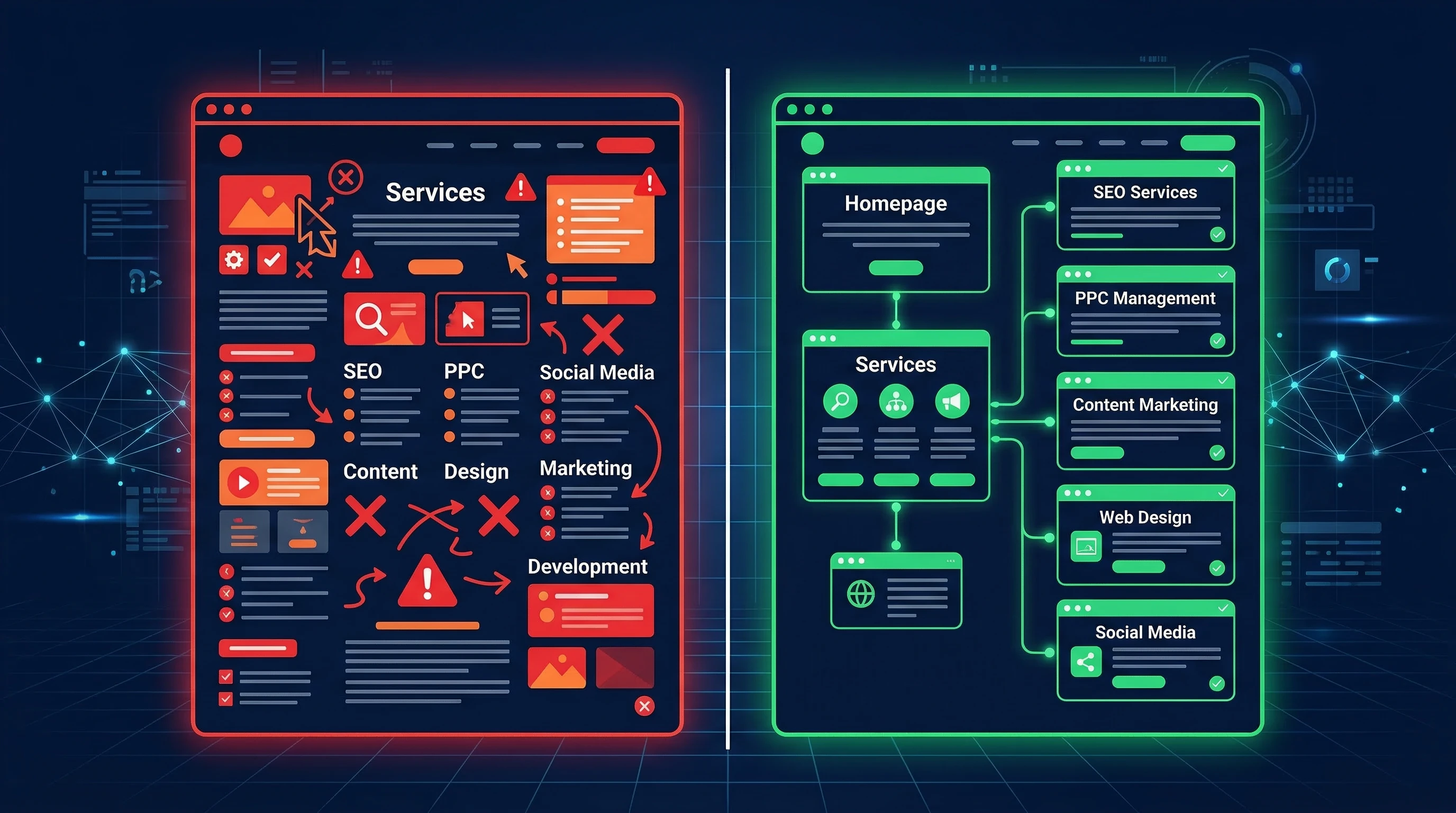
It might look something like this: you have a page called "Our Services" and you list everything you offer. Emergency plumbing, pipe leak repair, kitchen sink installation, all crammed together. You think you're being efficient. You're actually shooting yourself in the foot.
Here's why. When someone searches for "emergency plumbing," Google needs to find the best page that answers that specific search intent. Which page do you think it's going to choose? A page that mentions emergency plumbing alongside five other services? Or a dedicated page focused entirely on emergency plumbing?
The dedicated page wins every time.
Google doesn't rank websites. It ranks individual pages. One page, one service, one search intent. That's the rule.
And this isn't just a Google thing. It's even more critical for AI search engines. The more specific your pages are, the more likely you are to get cited. Remember: AI responses only reference a handful of sources, and pages with answer capsule structures see 40% higher citation rates.
How Should You Structure Your Service Pages? (3 Steps)
Break every service into its own dedicated page, organize them hierarchically, and connect them with internal links. Here are the three steps in detail.
Step 1: Identify Every Service and Give It a Page
List every service you offer (or plan to offer) and create a dedicated page for each one. Even if that's 10, 20, or 30 services, each one gets its own page.
Why? Because each page targets a specific keyword solving a specific problem your customer has. A single "services" page can't rank for 30 different keywords. Thirty dedicated pages can.
Step 2: Organize Pages Into a Logical Hierarchy
You still have one main "Services" parent page that lists everything. But each listing links to the dedicated service page underneath it. Your URL structure should follow the same hierarchy:
/services/emergency-plumbing/services/kitchen-sink-installation/services/pipe-leak-repair
This gives Google a clear signal about how your services relate to each other and builds topical authority across your entire site.
Step 3: Internally Link Between Related Services
Link from your emergency plumbing page to kitchen sink installation. Link from that page to pipe leak repair. And back again.
Internal linking is a critical component of SEO because it helps with three things: user navigation, faster indexing, and showing Google the overall structure and relationships across your site. Schema markup makes this even more powerful, with pages using structured data being 36% more likely to appear in AI summaries.
How Different Does Each Service Page Need to Be? (The 50% Rule)
At least 50% different from every other service page. If your pages look practically the same with just the service name swapped out, Google is smart enough to flag them for content duplication.
And in AI search, this is even more brutal. AI engines cite only one page from a group of "near-duplicates." That means 50 templated pages with the same content equals 49 wasted pages.
Here's what makes each page unique (it goes way beyond rewriting headlines):
SEO Fundamentals:
- Unique title tag with the service name, benefit, qualifier, and location
- Unique meta description
- Clean URL structure
- Different H1 for each page
Content Sections That Differentiate:
- Service introduction: How does this specific service solve a specific problem?
- How it works: Walk through the process for this particular service
- FAQs: Frequently asked questions specific to that service (bonus: FAQ schema gives you 3.2x higher citation probability in AI search)
- Pricing factors: What affects the cost of this particular service?
- Urgency-matched CTAs: Emergency plumbing gets "Call Now." Pipe leak detection gets "Book an Inspection." Small difference, big impact
- Service-specific reviews: Customer testimonials that mention that exact service
- Unique images: AI image generators can create realistic photos of you or your team performing each service
Steven, one of our AI Ranking community members, took this approach with over 800 location pages. He's now getting 105 appointments per month, with pages indexing in under an hour. The structure is what makes it work.
Why Does Service Schema Matter for AI Search?
Service schema is a small piece of code in the header of each service page that tells AI search engines exactly what's on that page, instantly and unambiguously.
Think of it as a translation layer. Structured data improves GPT-4's accuracy from 16% to 54% when processing page content, and pages with schema markup are 36% more likely to appear in AI summaries.
Each service page should have:
- Service schema describing what the service is, who provides it, and the service area
- FAQ schema for the frequently asked questions section
- Local business schema if you serve specific geographic areas
This is one of the easiest wins in SEO. You write the schema once per page, and it keeps working for you every time an AI search engine crawls your site.
How Do You Scale Service Pages Across Multiple Locations?
Use the same structure, but add a location layer on top.
If you're a plumber serving London, Manchester, and Birmingham, you need a location parent page that lists all your service areas. Each location then becomes its own parent page linking to the services offered there:
/locations/london/emergency-plumbing/locations/london/pipe-leak-repair/locations/manchester/emergency-plumbing
The 50% differentiation rule still applies. Here's how to make location pages unique without it being a nightmare:
- Embed a Google Map of that specific location (just search the area in Google Maps, click Share, then Embed, and paste the HTML at the bottom of the page)
- Area-specific details: Mention a local road, church, school, or landmark where it makes sense
- Location-specific schema: Local business schema that specifies the service area
- Location tags: Help Google understand which content belongs to which area
For local businesses, content quality beats proximity in AI search. AI Overviews have zero distance correlation, unlike the traditional Local Pack. That means a well-structured location page can outrank closer competitors who have sloppy site architecture.
How Do You Generate Unique Images for Every Service Page?
Use AI image generators. You don't need a photographer following you around.
Upload a photo of yourself (or your team) to an AI image generator like Google AI Studio and use a prompt that places you in the context of performing that specific service. For example: "A plumber fixing a leaky pipe underneath a kitchen sink, professional setting, natural lighting."
The result is a unique, realistic-looking photo for each service page. And here's the SEO bonus: you can add descriptive alt text to each image (something like "plumber in London fixing a leaky pipe"), which gives you another differentiation signal that both Google and AI search engines can pick up on.
These small 1% improvements compound. A unique image with a descriptive alt tag, combined with unique content, unique schema, and a unique CTA adds up to a page that is genuinely different from every other service page on your site.
Frequently Asked Questions
How many service pages should I create?
As many as you have distinct services. If you offer 15 services, you need 15 pages. Each one targets a specific keyword and solves a specific problem. Don't hold back because you think "too many pages" is a thing. Google and AI search engines prefer specificity.
Do I really need 50% unique content on every page?
Yes. While there's no official number from Google, SEO professionals consistently find that 40-50% is the minimum unique content threshold before pages start getting grouped as duplicates. Aim for 50% or higher to be safe.
Can I use AI to generate the content for service pages?
Absolutely. The key is making sure the AI generates genuinely different content for each page, not just swapping the service name. Use a prompt that focuses on the specific problem each service solves, the process, FAQs, and pricing factors. If you generate all pages with the same AI tool using the right prompts, it will naturally produce differentiated content.
What if I only serve one location?
You still need individual service pages. Skip the location layer and focus on making each service page as strong and differentiated as possible. Add your single location to the schema and title tags.
Ready to Fix Your Website Structure?
If you want the free service page checklist I mentioned (plus image generation prompts and a page content generation prompt), grab the AI Search Starter Kit. Just drop your email and I'll send everything over.
Inside the kit, you'll find:
- The complete service page checklist
- AI image generation prompts to create unique service photos
- A page generation prompt that ensures every service page is properly differentiated
- Stats and research sources to back up your SEO strategy
And if you want to go deeper, the AI Ranking community has weekly Q&As, a full course library, and 477+ members sharing what's working right now in AI search. William Moon, a financial advisor in Arizona, used these same structural principles to take his CTR from 0.3% to 2.3% and close a $165,000 deal from organic search.
Your website structure is the foundation everything else builds on. Get it right, and everything from content to schema to AI citations starts working in your favor.