
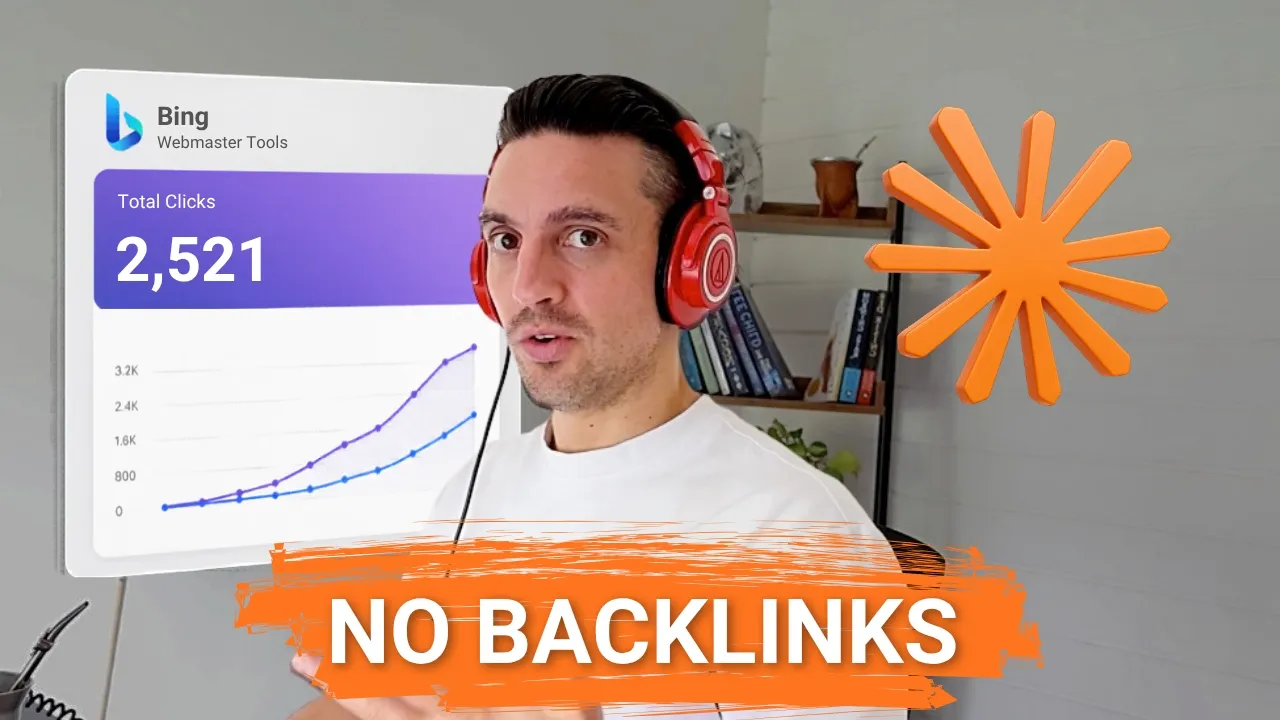
I built a Chilean fuel-price site with Claude Code in a weekend on Astro + Cloudflare. Thirty days later: 2,669 sessions and 2,500+ Bing clicks, traffic from ChatGPT, Perplexity and Copilot, and zero backlinks built. Here is the full workflow, niche to launch.
Can You Really Build and Rank a Website in 30 Minutes With AI?
Yes, the build itself takes about 30 minutes of focused work with Claude Code. Ranking is the patient part, but it happens fast when the fundamentals are in place.
I picked a fictional-sounding niche that was actually huge in Chile: live fuel prices. I bought preciocombustible.cl, opened Claude Code, and let it cook. Thirty days after going live, Google Analytics showed 2,669 sessions, the majority from organic search, plus citations and traffic from ChatGPT, Perplexity and Copilot.
No backlinks. No paid ads. No team. Just a weekend of vibe building on top of solid SEO fundamentals.
How Do You Pick a Niche Worth Building For?
Find a category that gets real search demand but has weak SEO from the incumbents. That gap is your opening.
I noticed fuel prices were chaotic worldwide, so I assumed there would be a country-by-country search habit for live prices. There was. The biggest Chilean competitor was pulling around 24,000 estimated monthly visits and ranking for 689 keywords, but their on-page SEO was rough. That is the dream scenario: clear demand, beatable execution.
A few rules I follow when sniffing out a niche like this:
- Real search volume for the head terms (use any keyword tool to confirm)
- Weak incumbent SEO (title tags, schema, internal linking, page speed)
- A country-code domain (.cl, .ie, .mx) for hyper-local intent
- An API or data source I can pipe into the site to auto-fill pages at scale
If all four boxes are ticked, the build is mostly an execution problem, not a strategy problem.
What Does the Claude Code Workflow Actually Look Like?
I dictate the idea into Otter.ai, paste the transcript into Claude Code, and run Plan Mode + Ultrathink before a single line of code gets written.
Plan Mode forces Claude to think before it builds. Ultrathink dials the reasoning effort up so it actually maps out the architecture, the API calls, the page structure, and the components. I add the competitor URL, the data API I want to use, the domain I bought, and the stack I want (Astro + Cloudflare).
From there, Claude spins up subagents in parallel: one for competitor analysis, one for API exploration, one for keyword research. That parallelism is the unlock. You are not waiting for one agent to finish, you are getting three streams of context at once.
By the time Claude comes back with the plan, the build is essentially de-risked. I just answer a few clarifying questions (open-source map vs. Google Maps, Cloudflare access, etc.) and let it run.
Why Astro + Cloudflare for SEO Sites?
Astro ships zero JavaScript by default, and Cloudflare gives you free global hosting plus a Workers deploy from inside Claude Code. That combination is hard to beat for SEO performance.
Static HTML + edge delivery means your pages load fast, get crawled cleanly, and score well on Core Web Vitals. With Wrangler permissioned inside Claude Code, the agent can push a staging site, attach a custom domain, and ship to production without me touching the Cloudflare dashboard.
Wrangler can do almost everything, except the things that matter most (it cannot purchase or delete a domain), which is exactly the safety boundary you want when you are letting an AI handle deploys.
How Do You Make an AI-Built Homepage Not Look Boring?
Feed Claude a design from a tool that specializes in design. I use Stitch by Google and screenshot the homepage Claude built first.
Then I ask Stitch to redesign it with a clear brief: fun, simple, fuel-price site for Chile. Stitch exports a PNG plus the HTML, and I drop both into the Claude Code folder. Then I tell Claude: take the design in this folder, rebuild the homepage to match it, use the Nano Banana Pro skill for any high-quality images, and add fluid hover animations.
A few minutes later the homepage went from generic to actually inviting. This is the trick most people miss: pair an AI coder with an AI designer. Do not make the coder do both jobs.
How Do You Generate Blog Posts That Match a Single Brand Look?
Tell Claude to write the blog, then make it spawn a side agent to define a permanent image style guide before generating any visuals.
For this site I asked for two posts: why are fuel prices rising in Chile, and where does Chile get its fuel. I told Claude to write roughly 70% of the post using the capsule content technique, link to sources, and include a five-question FAQ with the right schema.
Then I added one line that made everything consistent: launch a sub-agent to set the camera, focal length and style for every image, save it to the project file, and use it on every future image. Now every blog image, every hero, every section graphic looks like it was shot on the same camera in the same lighting. That visual consistency is brand-building on autopilot.
How Do You Hook Up Google Search Console and Analytics?
Two five-minute setups. Both have a Cloudflare shortcut that saves you the DNS pain.
- Add a domain property using your custom domain
- Click Start verification: if Cloudflare and Chrome are both signed into the same account, GSC auto-authorizes through Cloudflare
- Grab your sitemap URL from Claude Code and submit it under Sitemaps
For Google Analytics:
- Create a property, set the country/currency, pick Web as the platform
- Copy the gtag snippet and tell Claude Code to install it site-wide
- Verify with the free Tag Assistant Chrome extension before you celebrate
Pro tip: ask Claude to push the GA changes to production explicitly. The first time I tried this it installed the tag on staging only, and Tag Assistant flagged it. One follow-up prompt and it was live.
How Do You Fix PageSpeed Without Knowing What You Are Doing?
Screenshot the Google PageSpeed Insights report, drop it into Claude Code, and ask it to read the image and fix the issues.
Claude will catch the obvious wins: PNGs that should be WebP, lazy-loading on images below the fold, unused CSS. I literally just say: mobile is loading too slowly, read this screenshot carefully, make a plan, and convert any PNG to WebP.
A few minutes later your mobile score jumps. It is not magic, it is just that you have an engineer who never gets bored of fixing image formats. Steven, one of our community members, built 800+ location pages this way and now pulls 105 appointments per month with pages indexing in under an hour.
What Were the Actual 30-Day Results?
From launch on April 5 to May 11, the site pulled 2,669 sessions, 101 Google Search Console clicks, 2,500+ Bing clicks, and citations across ChatGPT, Perplexity and Copilot. Zero backlinks.
Here is the breakdown that surprised me most:
- Organic search drove the majority of sessions across Google, Bing and Yahoo
- Bing was the biggest traffic source, which matters because AI search traffic converts 4.4x better than traditional organic, and Bing powers Copilot plus a lot of ChatGPT browsing
- Six days in the site was already ranking for 85+ queries
- By week 4 Bing Webmaster Tools AI Performance dashboard was showing real citations inside ChatGPT
The lesson: if you are ignoring Bing Webmaster Tools, you are leaving a huge slice of AI traffic on the table. For some industries, especially desktop-heavy and work-laptop niches, Bing will out-perform Google for months.
Frequently Asked Questions
Do AI-built websites actually rank on Google?
Yes, if the content is genuinely useful and the technical SEO is solid. Google does not penalize AI-generated content as a category, it penalizes thin, unhelpful content. The ranking factors that matter are quality, relevance, structure, and Core Web Vitals, regardless of who or what wrote the page.
Can I really skip backlinks?
For low-competition local niches with weak incumbents, yes, at least for the first 30-90 days. Once you want to compete in saturated head terms, backlinks come back into play, but you can build a meaningful audience and revenue stream long before that point.
Why use Astro instead of WordPress?
Astro outputs static HTML with zero JavaScript by default, so it is faster and cleaner for search engines to crawl. WordPress can get there with the right plugins, but Astro is faster out of the box and pairs natively with Claude Code and Cloudflare for deploys.
How do I get cited by ChatGPT and Perplexity?
Structure your content so each section answers a specific question in the first 40-60 words, then expands. That is the capsule content method, and it is how studies on 8,000+ AI citations found pages get picked up by generative search.
Do I need to know how to code?
No. The entire build in this video was done in plain English. The skill you need is being clear about what you want and verifying that what Claude built actually matches your spec.
Ready to Build Sites That Rank Themselves?
If you want the exact workflow I use, including the capsule content method, the Claude Code SEO setup, and the new 7-day SEO action plan we just released, join the AI Ranking community. Membership also includes unlimited access to Datawise, the SEO tool you saw at the start of the video.
If you have questions about anything in this build, drop them in the YouTube comments. I read every one.
Resources
- Watch the full video on YouTube
- How to Make a Website with Claude & Astro (full tutorial)
- Capsule Content Method
- How to Do SEO for SearchGPT
- SEO in the Age of AI
- Turn Claude 4 Into Your Personal SEO Assistant
- Ahrefs: AI Search Traffic Converts 4.4x Better
- Search Engine Land: Insights From 8,000 AI Citations
- AI Ranking Community


