SEO Audit
A practical guide to auditing your website for traditional rankings and AI search, built for business owners who want a clear, prioritized fix list, not jargon.
What is an SEO audit?
An SEO audit is a structured review of your website that finds the technical, on-page, content and off-page issues holding back your search visibility, then turns them into a prioritized list of fixes. The goal is simple: see exactly why you are not ranking (or being cited by AI) and know what to change first.
A good audit checks how search engines crawl and index your site, whether your pages answer the right queries, how fast and stable the site is, and how trusted it looks to Google. In 2026 it also checks one more thing that most older guides skip: whether AI search engines like ChatGPT, Perplexity, Gemini and Google AI Overviews can read and cite your content.
You can run an SEO audit yourself with free tools, use a paid platform, or have it done for you. This page is the hub for our whole audit system: start here, then go deep with the step-by-step how-to, the full checklist, and the tools comparison below.
Why an SEO audit matters
Search visibility decays on its own. Pages that ranked last year slip as competitors publish, Google updates its algorithm, and your own content goes stale. An audit catches that decay early and protects the organic traffic you already earned.
It also catches expensive, invisible problems: pages accidentally set to noindex, broken redirects bleeding link equity, slow Core Web Vitals dragging down rankings, or a manual action (Google penalty) you never noticed. A single fixed crawl error can recover traffic that paid ads would cost thousands to replace.
More than that, your onsite SEO is the base that decides how well you can ever do in your niche. It sets the ceiling on your results. Trying to rank a site with weak onsite SEO is like racing in Formula 1 with a Toyota Prius: you will move, just not well, and never fast enough to beat the people who got the fundamentals right.
This still holds in the age of AI search. You will not have much luck getting cited by ChatGPT, Perplexity or Google AI Overviews if your fundamentals are broken, because these AI search engines are built on top of traditional search. They lean on the same crawling, indexing and trust signals. Fix the base first, and everything you layer on top of it works better.
When and how often to run one
- Quarterly: a light health check keeps small issues from compounding.
- After a site migration or redesign: these are the most common cause of sudden traffic loss.
- After a traffic drop or algorithm update: audit to find what changed.
- Before a big content push: fix the foundation before you build on it.
The 4 types of SEO audit
Most SEO audits cover four areas. You can audit all of them together or focus on one at a time.
| Type | What it checks | Examples |
|---|---|---|
| Technical SEO | Whether search engines can crawl, render and index your site | robots.txt, sitemaps, canonicals, Core Web Vitals, status codes |
| On-page SEO | Whether each page targets and answers the right query | title tags, headings, meta descriptions, internal links, content depth |
| Content SEO | Whether your content earns rankings and stays fresh | search intent, content decay, cannibalization, content gaps |
| Off-page SEO | How trusted and authoritative your site looks | backlink profile, referring domains, toxic links, brand mentions |
The deepest of these is the technical layer, which is why it gets its own technical SEO audit guide. The content side has its own content audit guide covering pruning, decay and AI citations.
How to perform an SEO audit (the short version)
- Crawl your site with a tool like Screaming Frog or your audit platform to surface broken links, redirects and duplicate pages.
- Check indexing in Google Search Console: which pages are indexed, which are excluded, and why.
- Audit on-page elements: title tags, meta descriptions, H1s, headings and internal links.
- Test Core Web Vitals and mobile-friendliness with PageSpeed Insights (LCP, INP, CLS).
- Run a content audit to find decaying, thin or cannibalizing pages.
- Review your backlink profile for toxic links and link gaps.
- Audit for AI search: can ChatGPT, Perplexity and AI Overviews crawl, read and cite your pages?
- Prioritize every finding by impact versus effort, then ship the fixes.
Each step has a full guide. Follow the complete how to do an SEO audit walkthrough, work the SEO audit checklist as you go, and pick your tooling from the SEO audit tools comparison.
Auditing your site for AI search and GEO
An AI search audit checks whether answer engines like ChatGPT, Perplexity, Gemini and Google AI Overviews can crawl your site, read your content, and cite you in their answers. This is the layer almost every classic audit ignores, and it is increasingly where buyers actually find you.
The mechanics overlap with classic SEO but add new checks. AI crawlers such as GPTBot, ClaudeBot, PerplexityBot and Google-Extended need to be allowed in robots.txt. Your most important answers should sit in the first sentence or two of a page so a model can lift them cleanly. Clean headings, lists and tables make content easy to extract, and schema plus real author signals raise trust.
This is the generative engine optimization (GEO) layer, and it is our specialty. Learn the full discipline in our AI SEO guide, and use your keyword research to map the questions AI search actually fans out into. An audit that ignores AI search is auditing yesterday's web.
New in your audit: agentic browsing
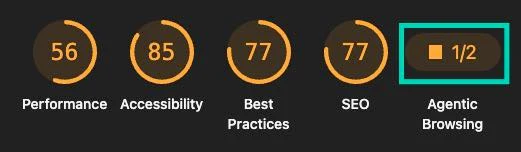
Google Lighthouse has added a new category that matters for this exact shift: agentic browsing. It measures how well an AI agent (the kind that browses the web on a person's behalf) can actually reach, read and act on your site. As agents do more of the clicking and buying, how agent-friendly your pages are becomes a real visibility factor, sitting right alongside the classic checks.
You can test it for free. Install Chrome Canary (an early-release build of Chrome), open DevTools, go to the Lighthouse tab, tick Agentic Browsing, and click Analyse page load. Alongside the usual Performance, Accessibility, Best Practices and SEO scores, you now get an agentic browsing result:
SEO audit tools (free and paid)
You can run a credible SEO audit for free. Google Search Console, Google Analytics and PageSpeed Insights cover indexing, traffic and performance at no cost, and Screaming Frog crawls up to 500 URLs free. Paid suites like Semrush Site Audit and Ahrefs Site Audit add automated scoring, scheduled crawls and prioritized issue lists.
Start free: check your site speed with GTmetrix
If you are not sure where to begin, run your homepage through GTmetrix, a free tool that grades your site speed and Core Web Vitals and shows what is slowing each page down. It returns a report like this:
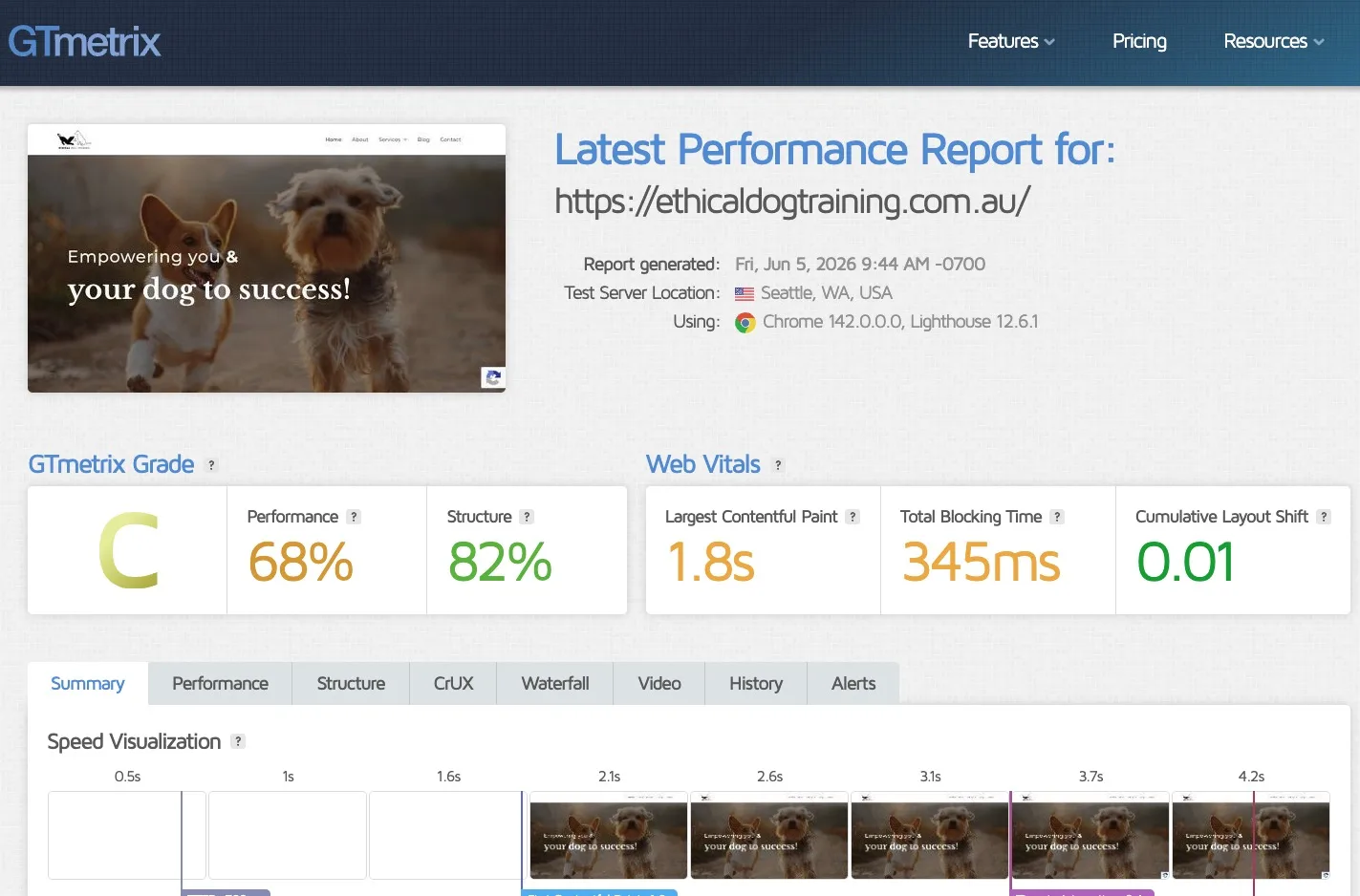
The catch is interpretation. Depending on your technical background, these reports can be hard to read: it is not always obvious what a metric means or what to actually do about it. Here is the shortcut we use. In our experience, around 70% of the time a site loads slowly because of heavy, uncompressed images, and GTmetrix points to the exact files dragging your page down. The fix is usually simple: compress those images and serve them as WebP. See our guides on optimizing images for SEO and using WebP.
If the report still feels too technical, the language really is jargon-heavy, you can hand it to this free GTmetrix Report Analyser custom GPT. Paste in your results (or a screenshot of the report) and it explains, in plain English, what each metric means and exactly what to fix first.
Inside the community, members use DataWise, our SEO tool that runs automated audits and returns a prioritized fix list covering both classic SEO and AI-search readiness in one pass. It is free for members. For the full breakdown of free versus paid options, see the SEO audit tools guide.
Everything in SEO Audits
SEO Audit Tools
The audit tools that surface the issues that actually matter.
Read the guideTechnical SEO Audit
Crawlability, indexing, speed and structure, step by step.
Read the guideContent Audit
Find pages to prune, merge, refresh or keep.
Read the guideSEO Audit Checklist
A complete, printable checklist for your next audit.
Read the guideHow to Do an SEO Audit
A start-to-finish walkthrough for beginners.
Read the guideLearn SEO Audits hands-on
Courses, two live calls a week, templates and DataWise. Everything you need to go from reading about it to ranking with it.
How we teach SEO Audits
Audits with a fix list, not a 200-page PDF
We teach you to turn any audit into a short, prioritized list of changes ranked by impact versus effort, so you ship fixes instead of drowning in data.
The AI-search audit layer
Every audit we run includes a GEO check: can ChatGPT, Perplexity, Gemini and Google AI Overviews crawl, read and cite your site? Most agencies still skip this entirely.
Done with you, inside the community
Members run real audits together using DataWise, our free-for-members tool, and get feedback on their fix lists from people doing the same work.
DataWise for SEO Audits
Our in-house SEO tool helps you run a full automated audit and get a prioritized fix list. It is included free with every paid membership, so you stop paying for five different tools.
See DataWise
SEO Audits wins from real members


SEO Audits FAQ
What is an SEO audit?
An SEO audit is a structured review of your website that finds technical, on-page, content and off-page issues hurting your search visibility, then turns them into a prioritized list of fixes. In 2026 a complete audit also checks whether AI search engines like ChatGPT, Perplexity and Google AI Overviews can read and cite your content.
How do you perform an SEO audit?
Crawl your site, check indexing in Google Search Console, audit on-page elements, test Core Web Vitals, run a content audit, review your backlink profile, and check AI-search readiness. Then prioritize every finding by impact versus effort and fix the highest-impact items first. Our step-by-step guide walks through each stage.
Which tool is best for an SEO audit?
For a free audit, combine Google Search Console, PageSpeed Insights and Screaming Frog. For automated scoring and scheduled audits, Semrush Site Audit and Ahrefs Site Audit are the leading paid platforms. Community members use DataWise, which audits classic SEO and AI-search readiness together and is free for members.
What are the 4 types of SEO?
The four areas an audit covers are technical SEO (crawling and indexing), on-page SEO (titles, headings and content per page), content SEO (intent, decay and gaps), and off-page SEO (backlinks and authority). A full audit reviews all four, plus AI-search readiness.
How often should I run an SEO audit?
Run a light audit quarterly to catch decay early, and a full audit after any site migration, redesign, traffic drop or major algorithm update. Auditing before a big content push also pays off, because it fixes the foundation before you build on it.
How long does an SEO audit take?
A basic audit of a small site takes a few hours. A thorough audit of a large site, including content and backlink analysis, can take several days. Automated tools shorten the data-gathering, so most of your time goes to interpreting findings and prioritizing fixes.
Is SEO replaced by AI in 2026?
No. SEO is evolving, not dying. AI search engines still pull from crawlable, well-structured, trusted pages, so the fundamentals an audit checks still matter. What changes is that you now also audit for AI citation: getting ChatGPT, Perplexity and AI Overviews to read and recommend you. That is exactly what we teach.
Win at SEO Audits with people who have your back
Join 7,400+ business owners, agencies and freelancers learning AI search engine optimization together.