AI SEO
Use AI to do SEO faster, and optimize so AI search engines cite and recommend you. A practitioner's guide for business owners and marketers.
What is AI SEO?
AI SEO is the practice of using artificial intelligence to do search engine optimization faster, and optimizing your content so AI search engines like ChatGPT, Perplexity, Gemini and Google AI Overviews mention, cite and recommend you. It has two sides: using AI as a tool to speed up SEO work, and earning visibility inside AI-generated answers.
The first side is familiar work made faster. AI helps with keyword research, content briefs, drafts, technical audits and reporting. The second side is newer and is where most of the opportunity sits in 2026: a growing share of searches now end in an AI answer instead of a list of links, so the goal shifts from ranking a page to being the source the model pulls from.
Both sides are covered on this page and in the guides below, from the best AI SEO tools to using ChatGPT for SEO and SEO AI agents that run the work for you.
How AI changed search
AI has been inside Google search for years. RankBrain (2015), BERT (2019) and MUM (2021) taught Google to understand the meaning and intent behind queries rather than just matching keywords. What changed recently is that AI now writes the answer on the results page itself, through Google AI Overviews and AI Mode, and through standalone assistants like ChatGPT, Perplexity and Gemini.
The practical effect is more zero-click search. When the answer appears at the top, fewer people scroll to the classic blue links, so traditional rankings alone capture less traffic than they used to. The winners are the brands cited as sources inside those AI answers.
The shift is already in the data. Semrush found AI Overviews now appear on 15.69% of Google queries, more than double the rate at the start of 2025, while Adobe measured a 1,200% jump in traffic from generative AI sources in a single year. At the same time Bain estimates about 60% of searches now end without a click. The traffic is not gone, it is moving into AI answers, and AI SEO is how you follow it there.
AI SEO vs traditional SEO
AI SEO is not a replacement for traditional SEO, it is a layer on top of it. The fundamentals still matter: crawlable pages, fast Core Web Vitals (LCP, CLS, INP), clean information architecture, internal linking and real authority. AI engines often draw from pages that already rank and are trusted, so good SEO feeds good AI visibility.
AI will not replace your job. But the person doing your job with AI will. That is the mindset we open our 7-day action plan with, and it is just as true for SEO itself: AI does not replace the work, it sits on top of it.
| Traditional SEO | AI SEO | |
|---|---|---|
| Goal | Rank in the list of links | Get mentioned, cited and recommended in AI answers |
| Unit of success | Position in the SERP | Mention share and citation rate across AI engines |
| Surfaces | Google, Bing organic | AI Overviews, ChatGPT, Perplexity, Gemini, Copilot |
| Content focus | Keyword targeting | Direct answers, entity coverage, extractable structure |
The SEO pyramid: why AI is the top layer, not the foundation
When we teach this inside our 7-day action plan, we draw it as a pyramid, because the order matters as much as the parts. You build from the base up, and each layer only works once the one beneath it is solid:
- Technical SEO (the base). Crawlability and indexing. This is where most people quietly lose. Publishing a page does not mean an AI engine will crawl it, and getting crawled does not mean it gets indexed. If engines cannot read and store your page, nothing above this layer matters.
- Good content. Unique, genuinely useful content that answers the question. We say it plainly to members: not all AI content is spam, but all spam content is AI. The right content beats more content, every time, so a sharp 800-word page can outperform a padded 3,000-word one.
- Authority and trust (E-E-A-T). Experience, Expertise, Authoritativeness and Trust, earned through reviews, citations, backlinks and real signals that you are who you say you are. Backlinks matter less than they used to, but they still move the needle in AI search.
- The AI layer (GEO). The patterns that get you cited inside AI answers. This is the layer everyone is racing toward, but it only compounds once the three layers below it are in place.
This is the one idea to take from this page. Most people fail at AI search because they jump straight to the AI layer while their crawlability or their content is broken. GEO is not a brand new game with different rules, it is the same SEO signals with a few patterns layered on top. Get the fundamentals right and the AI layer pays off. Skip them and no amount of GEO tactics will save you. Remember that at the end of the day you are ranking for humans, and now for machines too.
What AI SEO is called: GEO, AEO and LLMO
AI SEO goes by several overlapping names. The most common are GEO (Generative Engine Optimization), AEO (Answer Engine Optimization) and LLMO (Large Language Model Optimization). They all describe the same shift: getting recommended inside AI-generated answers instead of only ranking in a link list.
- GEO (Generative Engine Optimization): optimizing to be cited by generative AI engines. See our GEO guide.
- AEO (Answer Engine Optimization): structuring content to be the direct answer to a question.
- LLMO (Large Language Model Optimization): tuning content and entity signals for how LLMs retrieve and quote sources.
Here is our honest take after watching new acronyms appear on LinkedIn almost weekly: they all describe one shift, not many, so do not let the jargon overwhelm you. The term we use is GEO, because it is the only one that has been published in a peer-reviewed paper rather than coined in a viral post. Whatever label wins, the work underneath does not change: classic SEO signals, plus a few patterns that make your content easy for a generative engine to quote.
Fan-out queries: the mechanic unique to AI search
A fan-out query is what happens when an AI search engine takes your one question and quietly breaks it into many related sub-questions, runs them all at once, and assembles a single answer from the best source for each. You ask one thing, but behind the scenes the engine searches for a dozen. Google openly describes its AI Mode as using a query fan-out technique, and ChatGPT, Perplexity and Gemini all work the same way.
Say someone asks for "the best CRM for a small plumbing business". Before it answers, the engine fans that out into the questions a good answer would need to cover:
- What features does a small field-service business actually need in a CRM?
- How much do CRMs cost for a small team?
- Which CRMs have a solid mobile app for techs in the field?
- What software do plumbing businesses use?
- Which options integrate with invoicing and scheduling?
This is the part that only exists in AI search. On a classic Google search, you do the fan-out yourself: you run one query, skim the links, run another, and piece the answer together across several searches and tabs. An AI engine does all of that internally and hands you the finished answer. So you are no longer competing for a single keyword, you are competing to be the best source across a whole cluster of sub-questions the searcher never even typed.
The practical takeaway: a page that nails only the head term can still win a traditional blue link while losing the AI answer, because the engine could not find your coverage of the sub-questions. The fix is to map the fan-out for your topic and answer each sub-question directly on the page. We go deep on how to do that in the query fan-out guide.
Getting cited by AI engines (ChatGPT, Perplexity, Gemini)
To get cited by AI engines, give a direct answer in your first one or two sentences, structure content so passages are easy to extract, cover the full topic the model fans out into, and build mention share by being referenced across the web. AI search rewards clarity, structure and trust more than keyword density.
- Answer first: lead every page and section with the direct, quotable answer.
- Extractable structure: clean H2/H3 headings, short paragraphs, lists and comparison tables an engine can lift.
- Entity coverage: name the people, tools, methods and concepts a complete answer needs.
- E-E-A-T and mention share: a real author, citations and being mentioned on other sites raise your odds of a citation.
This is the heart of generative engine optimization, and it is the differentiator most AI SEO guides skip.
You can start earning AI citations this week
- Pick one money page and rewrite it answer-first, so models can quote it cleanly.
- Run your top prompts through ChatGPT and Perplexity to see where you already show up.
- Bring the page to the twice-weekly live Q&A and get it checked before you publish.
Structured data, entities and E-E-A-T for AI
Structured data and entity signals help AI engines understand and trust your content. Schema markup (JSON-LD types like FAQPage and WebPage) makes your facts machine-readable, while consistent entity signals (your brand, author and topics referenced across the web) build the topical authority models look for. Pair that with strong E-E-A-T (Experience, Expertise, Authoritativeness, Trustworthiness) through real authors, sources and a clear about page.
How to measure AI SEO
You measure AI SEO with AI visibility metrics, not rankings, and in 2026 it comes down to two numbers worth tracking with real seriousness: your citations and, more importantly, your mentions. A citation is when an AI engine links to your page as a source. A mention is when your brand name actually appears in the answer. They are not the same thing, and the gap between them is where most brands are flying blind.
Mentions are climbing the priority list because they are finally becoming measurable inside the tools you already use. Google has introduced generative AI performance reports in Search Console, and Bing has reported on AI and Copilot visibility for a while now. The signal that used to be invisible is starting to show up in your own dashboards.
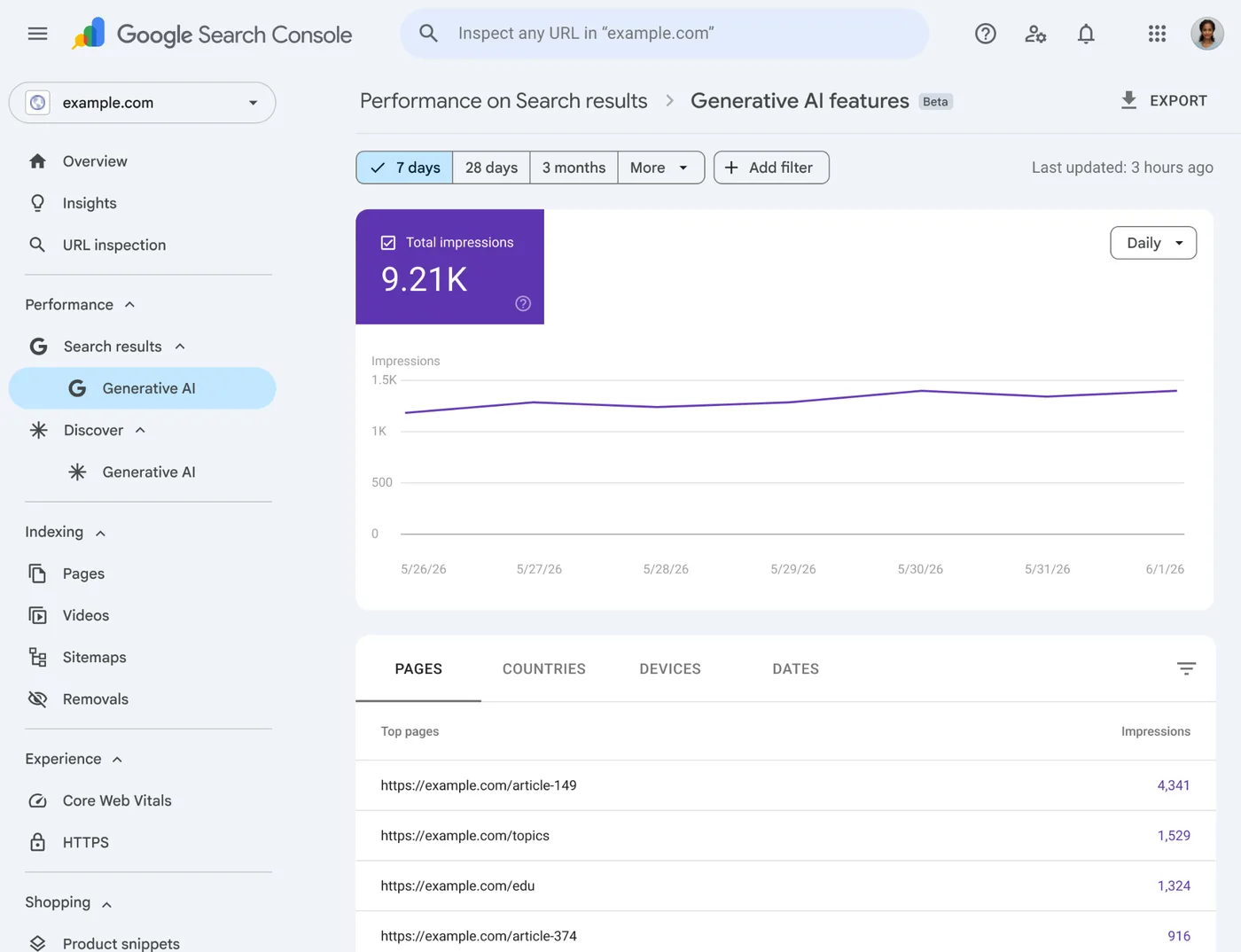
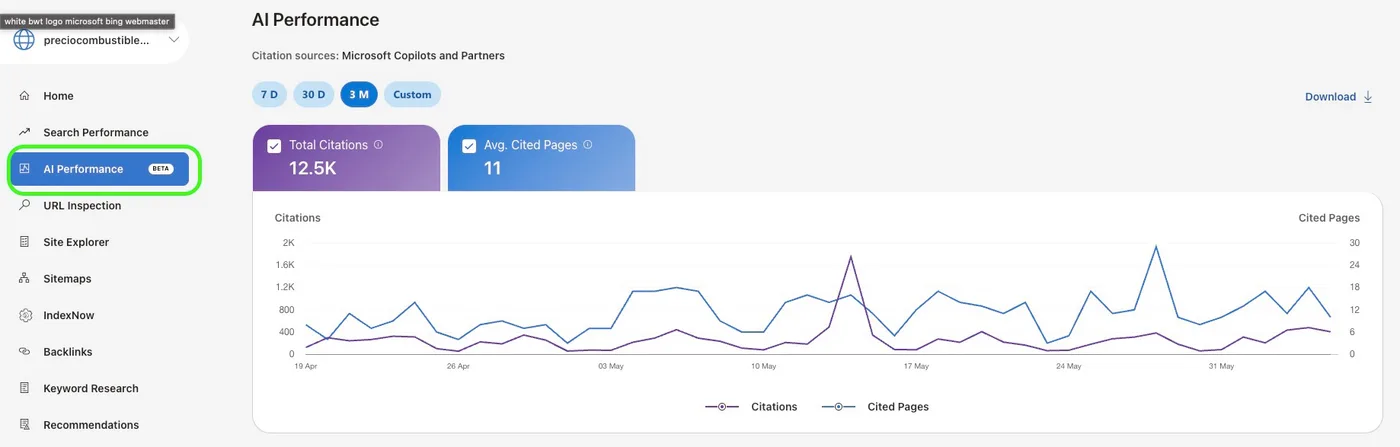
We get a close-up view of this. One of the guests in our live Q&As is Denis Pavlovsky, CMO of DataForSEO. When we asked him which new KPI deserves the most attention, his answer was blunt:
The most important new KPI is the mentions of your brand, because your brand can get cited by AI search engines but not necessarily mentioned.
In other words, a link is not the whole story. An engine can pull from your page and cite the URL without ever naming you, and it can recommend you by name with no clickable citation at all. The brand mention is what builds recognition and demand, so it is the number to watch as AI answers replace the click.
In practice, track a set of target prompts across ChatGPT, Perplexity, Gemini and Google AI Overviews, then log two things for each: were you cited, and were you mentioned by name. Run the same prompts on a schedule so you can watch the trend. Our tool DataWise (free for community members) does this for you: it runs your prompts, scores both your citations and your brand mentions, and audits pages for citation readiness.
Is SEO dead in 2026?
No, SEO is not dead in 2026, it is evolving into AI search optimization. The core job, helping the right people find and trust your content, is unchanged. What changed is the surface: a large share of discovery now happens inside AI answers, so SEO now includes getting cited by AI engines, not only ranking links.
Here is how we put it to members. SEO is search engine optimization: the act of optimizing your online presence so you get seen better. That job does not disappear because the search engine changed. It now spans Google and AI Overviews, but it also spans YouTube, TikTok, Pinterest and ChatGPT, each of which is a search engine in its own right. The surfaces keep multiplying while the goal stays the same, so SEO is not dying, it is spreading. The only thing that actually dies is the assumption that ten blue links were ever the whole game.
How to do AI SEO (the short version)
- Answer the core question directly and early on every page.
- Use AI tools to scale research, briefs, drafts, audits and reporting (without skipping human review).
- Structure content with clear headings, lists and tables that AI can extract.
- Cover the full topic, including the sub-questions AI fans out into.
- Build trust signals: a real author, schema, citations and external mentions.
- Track AI visibility (mention share, citation rate, AI traffic) and double down on what works.
Each piece has its own guide: SEO automation for scaling the work, SEO AI agents for running it autonomously, the best AI SEO tools for the stack, programmatic SEO for scaling citable pages, and ChatGPT for SEO for hands-on prompting.
Learn AI SEO inside the community
AI SEO moves fast, and most of what works is not in blog posts yet. Inside the AI Ranking community we teach the full system: the playbook for earning citations, the tool stack, agent templates and prompts, and live feedback on your pages. Members also get DataWise free to track their AI visibility.
Everything in AI SEO
SEO Automation Guide
Automate the repetitive 80% of SEO so you can focus on what moves rankings.
Read the guideSEO AI Agents
Build agents that audit, research and optimize on autopilot.
Read the guideBest AI SEO Tools
The AI SEO tools actually worth paying for in 2026, tested.
Read the guideProgrammatic SEO
Publish hundreds of quality pages from one template and a dataset.
Read the guideChatGPT for SEO
The prompts and workflows that turn ChatGPT into an SEO teammate.
Read the guideLearn AI SEO hands-on
Courses, two live calls a week, templates and DataWise. Everything you need to go from reading about it to ranking with it.
How we teach AI SEO
The citation playbook
We teach the exact steps to get mentioned and cited by ChatGPT, Perplexity, Gemini and AI Overviews, not just generic AI SEO theory.
Track your AI visibility
Members use DataWise free to monitor mention share and citation rate across AI engines and see what is moving the needle.
Tools, agents and templates
Get the working tool stack, SEO AI agent templates, prompts and automation workflows our members use in production.
DataWise for AI SEO
Our in-house SEO tool helps you automated site audits + content optimization in one click. It is included free with every paid membership, so you stop paying for five different tools.
See DataWise
AI SEO wins from real members


AI SEO FAQ
What is AI SEO and how do you do it?
AI SEO is using AI to do SEO faster and optimizing your content so AI search engines cite and recommend you. You do it by answering questions directly, structuring content for easy extraction, covering the full topic, building trust signals like authorship and schema, and tracking your AI visibility across ChatGPT, Perplexity, Gemini and Google AI Overviews.
Can SEO be done by AI?
Partly. AI can accelerate keyword research, content briefs, drafts, technical audits and reporting, and AI agents can run multi-step workflows. But it cannot replace strategy, brand judgment and real expertise (E-E-A-T). The best results come from AI augmenting a human, not replacing one.
Is SEO dead or evolving in 2026?
SEO is not dead in 2026, it is evolving into AI search optimization. The goal of helping people find and trust your content is unchanged, but discovery now happens partly inside AI answers, so SEO now includes getting cited by AI engines, not only ranking links.
What is the best AI SEO tool?
There is no single best tool; the right stack depends on your goal. Surfer and Clearscope lead for content optimization, Semrush and Ahrefs for research, and a new class of tools tracks AI visibility. Our tool DataWise scores your AI visibility and audits pages for citation readiness, and it is free for community members. See our best AI SEO tools guide.
Is ChatGPT good for SEO?
Yes for ideation, drafting, clustering and on-page tasks, with caveats. ChatGPT speeds up keyword research, briefs, titles, metas and outlines, but it can hallucinate facts and citations, so a human must verify and edit. Treat it as a fast assistant, not an autopilot. Our ChatGPT for SEO guide covers prompts and limits.
What is replacing SEO?
Nothing is replacing SEO; it is expanding to include AI search. The new layer is generative engine optimization (GEO) and answer engine optimization (AEO): getting mentioned and cited inside AI-generated answers from ChatGPT, Perplexity, Gemini and Google AI Overviews.
What is AI SEO called?
AI SEO goes by several overlapping names: GEO (Generative Engine Optimization), AEO (Answer Engine Optimization) and LLMO (Large Language Model Optimization). They all describe optimizing your content to be cited and recommended inside AI-generated answers. We use GEO, because it is the only one published in a peer-reviewed paper rather than coined on LinkedIn.
Is GEO a brand new game or just a layer on top of SEO?
It is a layer on top, not a new game. Generative engine optimization uses the same SEO signals (crawlable pages, useful content, authority and trust) with a few patterns added so AI engines can quote you. We teach it as a pyramid: technical SEO at the base, then content, then authority and E-E-A-T, then the AI layer on top. You cannot skip a floor, because the AI layer only pays off once the fundamentals beneath it are solid.
What is the difference between a citation and a mention in AI search?
A citation is when an AI engine links to your page as a source. A mention is when your brand name appears in the answer text. They do not always go together: you can be cited by URL without being named, and named without a clickable citation. Track both, but treat brand mentions as the priority KPI, since that is what builds recognition. Google's new generative AI performance reports in Search Console and Bing's AI reporting are starting to make this measurable.
What is a fan-out query in AI search?
A fan-out query is when an AI search engine takes your single question, breaks it into many related sub-questions, runs them all at once, and builds one answer from the best source for each. Google describes its AI Mode as using a query fan-out technique, and ChatGPT, Perplexity and Gemini work the same way. It is unique to AI search: on a classic search you do the fan-out yourself across several queries, while an AI engine does it internally. To win, your page has to answer the sub-questions, not just the head term.
Win at AI SEO with people who have your back
Join 7,400+ business owners, agencies and freelancers learning AI search engine optimization together.