
So GPT-5 is here, and as usual, the internet has split into two camps: people who love it, and people who think it’s the worst thing to happen since autocorrect decided to “fix” your texts. Honestly, I think a lot of the hate comes from people not using it correctly. I’ve just spent seven days reading, watching, and pushing GPT-5 to its limits, so here’s the straight-to-the-point guide you actually need.
1. Unlock All the Hidden Models
When you open the model selector, you’ll probably only see:
- Auto
- Fast
- Thinking
- Pro (if you’re on the $200/month plan)
If you scroll down to "Legacy models," you might spot GPT-4o. But here’s the thing: there’s way more available.
Here’s how to unlock them:
- Go to Settings
- Open the General tab
- Toggle Show additional models
Now, under GPT-5, you’ll see Thinking Mini, which is fantastic for copywriting and lighter creative work.
Which one should you use?
- Auto: GPT will pick based on complexity. Simple = Fast, complex = Thinking.
- Thinking: Better for complex, multi-step reasoning.
- Fast: Cheap, efficient, and surprisingly good. Great default.
- Thinking Mini: Like Thinking, but lighter and faster.
OpenAI’s routing system tends to pick the cheaper (Fast) option if possible. You can always start a chat with Thinking for context, then switch to Fast to save time and credits.
And yes, if you’re still emotionally attached to old favorites like GPT-4.1 or GPT-3.5, they live in the Legacy models section. OpenAI brought them back after a very vocal backlash.
2. Play With the New Personalities
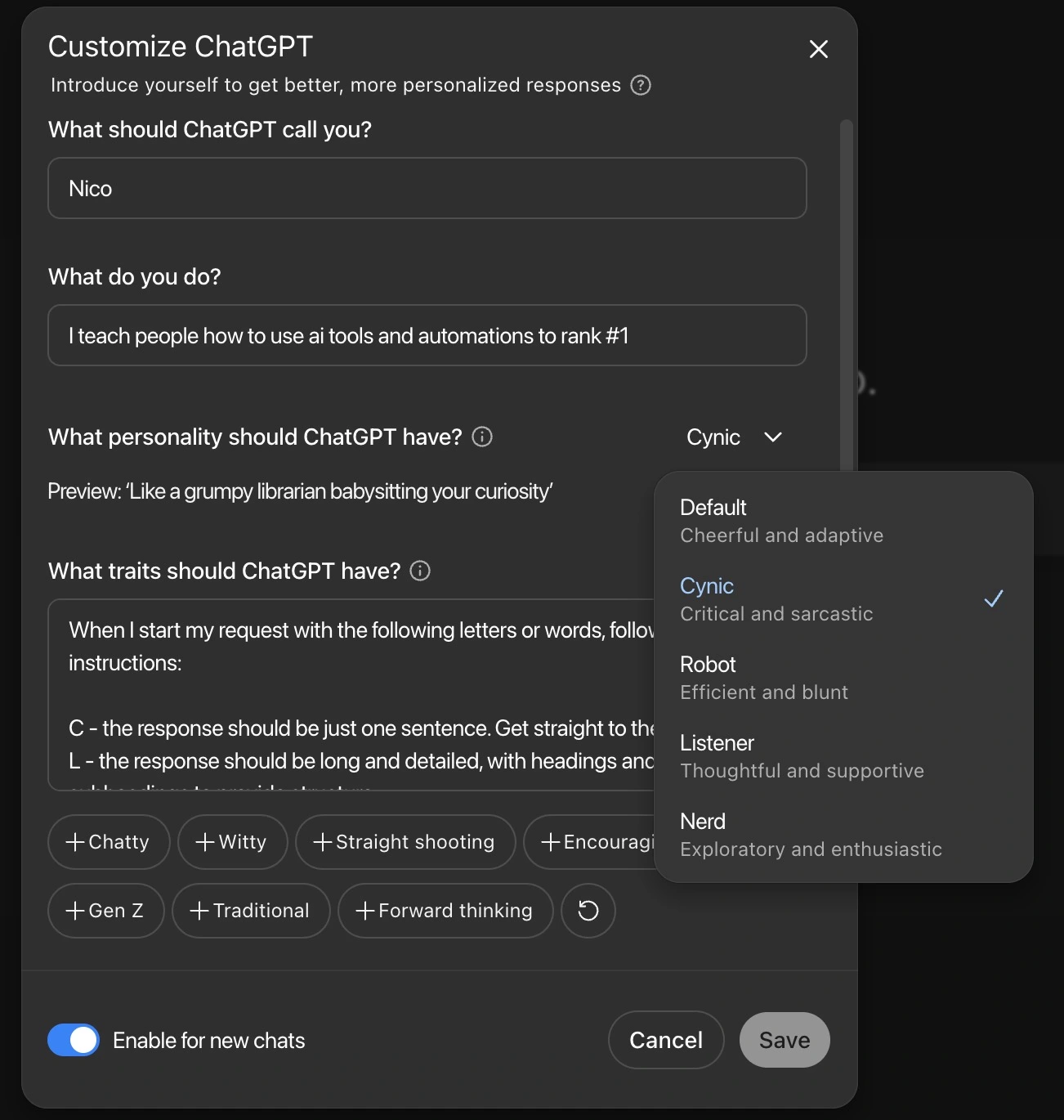
GPT-5 now lets you pick a built-in personality. At first, I thought these were a bit of a gimmick, but the more I use them, the more I realize they’re surprisingly useful:
- Cynic: Snarky, blunt, and great for no-nonsense feedback. My personal favorite.
- Robot: Zero small talk. Just gets to the point. Perfect for coding or rapid drafting.
- Listener: Supportive and empathetic. Weird to say about an AI, but some people genuinely use it for emotional support.
- Nerd: Excited, thorough, and detail-obsessed. Perfect for learning something in depth.
Switch them up and see which fits your workflow. I’ve found Cynic is great for constructive criticism, and Robot is a huge time saver.
You can access all these personalities by going to the Customize ChatGPT.
3. Use the Canvas Feature for Apps and Dashboards
Canvas is GPT-5’s built-in interactive workspace. You can:
- Build games
- Create data dashboards
- Make interactive reports
You can share these with anyone, even if they don’t have a ChatGPT account. This makes it a goldmine for lead generation, imagine sending an interactive report that doubles as a pitch.
4. (Gimmick Alert) Change Your Highlight Colour
It’s cosmetic, not functional, but you can change your GPT interface accent colour to blue, green, yellow, pink, orange, or purple. It’s the kind of feature Apple would hype up as a major release, even though it won’t make GPT-5 any smarter. Still, it does make the workspace feel less sterile.
5. Use the Prompt Enhancer to Fix Bad Prompts
If GPT-5 isn’t giving you what you want, stop blaming the model. Prompting is just communication, and bad prompts = bad results. OpenAI’s Prompt Enhancer (available in the Playground) takes your vague or poorly written prompt and turns it into something far more specific.
Poorly defined prompts are one of the biggest reasons people fail to get good AI outputs. In fact, research shows that improving prompt clarity can boost task accuracy by up to 30% (Stanford HAI). Use the enhancer and you’ll instantly see better results.
Bottom line: GPT-5 is incredibly capable, but only if you unlock all the tools and actually use them. Stop treating it like a magic trick and start treating it like the power tool it is.

Explore Our Latest Insights
Stay updated with our recent blog posts.
Local SEO is not a checklist of 50 things. It is four automated systems: a citations auditor, an on-site page checker, a Google Business Profile content feed, and a smart review responder. The same setup is getting one local business 99 booked appointments a month from organic alone. No ads, no agency, no cold outreach.
Why does local SEO feel so overwhelming?
Because most people treat it like a checklist of 50 disconnected tasks, when the reality is much simpler when it is done correctly. Local SEO really splits into two halves: your website, and your Google Business Profile. Once you see it that way, the chaos turns into four systems you can automate and forget.
That is exactly what one local business did. It is now pulling 99 booked appointments every single month from organic traffic alone, ranking in the map packs, and getting recommended by Google's AI Overviews when someone searches for their service locally. No ad spend. No agency. No cold outreach. Just systems running on autopilot.
This matters more than ever in 2026, because traffic from AI search engines now converts roughly five times better than traditional organic clicks, and local queries are some of the lowest-competition AI Overview real estate left. Local businesses that get the structure right beat competitors spending ten times more on ads.
What are the 4 systems that automate local SEO?
The four systems are a local citations auditor, an on-site page checker, a Google Business Profile content feed, and a smart review responder. The first two fix your website. The last two run your Google Business Profile like a social channel without you touching it.
Here is how they break down:
- System 1: Citations auditor. A Claude skill that finds every relevant local directory you should be listed in and hands you a consistent NAP block.
- System 2: On-site page checker. A Claude skill that audits whether your service pages are even indexable, plus schema, content depth, and internal links.
- System 3: Google Business Profile content feed. A Pabbly automation that pushes your Instagram media and your blog posts to your profile automatically.
- System 4: Smart review responder. A Pabbly plus Claude automation that replies to positive reviews instantly and routes negative ones to a human.
This is the same "systems feed each other" approach behind the 4 Claude Code systems that run my entire SEO workflow, just pointed at local.
How does the local citations auditor work?
It crawls the business website, understands what the business actually does, and returns every relevant local citation directory plus a locked NAP block to use everywhere. Citations are other local or business directory sites linking to and mentioning you, and they add real trust because they prove you are a genuine business.
You install it once as a skill in the Claude desktop app (Settings, then create a new skill, then upload the zipped skill file). After that you just say "using the local citation skill, run this site" and give it the URL.
What comes back is specific, not generic. For a wedding catering business it surfaced the obvious ones (Google Business, Bing Places, Yelp) and then niche gold like a wedding suppliers directory and a restaurant and catering industry association. Some are free, some are paid, and you decide what is worth it.
The critical output is the NAP block: name, address, and phone number that must stay byte-for-byte identical across every listing. Inconsistent NAP is one of the quietest local SEO killers. Ask Claude to export the list as a CSV so you can track which directories are done.
If you have budget but no time, a service like BrightLocal will build citations for you at roughly $3.20 each, so about $30 covers a solid batch. The skill route is free and just costs you the upload time.
How do you know if your pages are even getting indexed?
You run the on-site page checker skill against each service page, because publishing a page does not mean Google has added it to its index. This is the most important of the website systems, and the one almost everyone skips.
Grab a specific service URL (say your "corporate events" page), hand it to the local business auditor skill, and you get a prioritised report covering:
- Indexability, so you know if the page is actually in Google at all
- Schema markup, which is usually missing and is the translation layer AI uses to understand you
- Content depth and quality flagged in plain red or green status
- NAP consistency on the page itself
- Internal linking, images, and file issues
Schema is a force multiplier here: structured data measurably increases the odds you show up in AI summaries, and missing it is the difference between a page that ranks and one that is invisible. You do not need to run this weekly. Once every six months per page is plenty.
Community win: William Moon, a financial advisor in Arizona, used this exact "fix the page, add the structure" approach and took one page from a 0.3% click-through rate to 2.3%, then closed a $165,000 deal off the back of it. Structure on the page is not busywork. It is revenue.
How do you automate your Google Business Profile content?
You treat your profile like a social media account and let Pabbly feed it for you, because Google rewards active profiles and there is a strong correlation between profiles with 100-plus images or videos and the ones that actually perform. The catch is finding the time, so you automate two flows.
Flow 1: Instagram to Google Business Profile. In Pabbly Connect, the trigger is a new Instagram media post. A router splits videos from photos, and each branch uploads the media straight to the Google Business Profile using the standard Google Business connection (no developer access needed, which is the part people usually get rejected for). You already make this content, so the profile fills itself.
Flow 2: Blog post to Google Business Profile post. The trigger is a new or changed CMS collection item from your site (Webflow, WordPress, Wix, anything Pabbly connects to). The blog content is passed to Claude through the Anthropic connection with a system prompt that rewrites it under the 1,500 character profile limit, in your tone of voice. Then it posts back as a call-to-action update linking to the full article.
One sane tip from the build: do not use Opus for the rewrite. As I put it in the video, that is "the equivalent of using a Ferrari to drop your kids off to school." Sonnet 4.5 or 4.6 with around 3,000 max tokens is the right tool. This is the same Claude-as-your-SEO-assistant pattern, just wired into an automation instead of a chat window.
Pick a content source you know you will actually publish to regularly. If you write blogs, use blogs. If you live on LinkedIn, trigger off that instead. The automation only works if the source keeps producing.
What is the right way to handle Google reviews at scale?
Auto-respond to every positive review, and keep a human in the loop for negative ones. Responding to reviews matters for both ranking and trust, but the two types need completely different handling, so the automation forks on the star rating.
For positive reviews (4 and 5 stars), the rules are: thank them, acknowledge the specific thing they mentioned, and invite them back. Mentioning the service and location in the reply also helps you with Google's newer Ask Maps mode. In Pabbly the flow is: new review trigger, router on star rating, pass the reviewer name and comment to Claude (Sonnet 4.6) with a tuned system prompt, then post the reply back. The responses come out warm and specific, not robotic, because the prompt has full context.
For negative reviews (1 to 3 stars), do not automate the reply. Too much can go wrong, and a bad automated response to an unhappy customer is worse than no response. Instead, the flow emails the business owner or manager an alert with the reviewer name, the comment, and a link to the profile. The human writes the reply: thank them, acknowledge the experience, and take it offline fast (give them a direct email to resolve it).
That public "we owned it and fixed it" response is its own trust signal. People reading reviews trust a business that handled one bad experience well more than a business with zero negatives.
Community win: Tim Armstrong had a client land a mortgage lead directly from a ChatGPT recommendation. The prospect literally said ChatGPT told them this was the best option. That is what happens when your reviews, citations, and on-page structure all line up: the AI starts recommending you by name. It is the same outcome behind ranking inside ChatGPT itself.
Do these systems actually move the needle?
Yes, and the numbers back it up. The business in this build is at 99 booked appointments a month from organic alone. Another member, Steven, runs 800-plus location pages generating around 105 appointments a month, with new pages indexing in under an hour because the on-site structure is dialled in.
The wider data explains why local is such an opportunity right now:
- Around 40% of local business queries already trigger AI Overviews, and pure local searches have very low AI Overview competition
- In AI Overviews there is zero distance correlation, unlike the Local Pack, so content quality can beat proximity
- Pages that get cited overwhelmingly lead with a structured, extractable answer, which is why the capsule content method works as well for local pages as it does for blog posts
Four systems, two halves of local SEO, running themselves. That is the whole game.
Frequently Asked Questions
What is a NAP block and why does it matter so much?
NAP is your business Name, Address, and Phone number. It has to be identical across every directory and citation, because inconsistent NAP signals to Google that you might not be a single legitimate business, which suppresses local rankings. The citations auditor skill generates one canonical block so you copy and paste the same thing everywhere.
Do I need developer access to automate Google Business Profile?
No. The standard Google Business connection in Pabbly is enough for uploading media and posting updates. The developer API is the path that often gets rejected, and you can skip it entirely for these flows.
How often should I run the on-site page checker?
Roughly every six months per service page, not constantly. Pages decay and fall out of the index over time, so a twice-yearly pass catching indexability, schema, and content gaps is the right cadence. This is the same logic behind a content refresher in a wider SEO system.
Should I automate replies to negative reviews?
No. Automate positive reviews only. Negative reviews need a human who can acknowledge the specific issue and move the conversation offline. A tone-deaf automated reply to an upset customer does more damage than staying silent.
Which Claude model should the automations use?
Sonnet (4.5 or 4.6) for both the blog rewrite and the review responder. Opus is overkill for short-form rewriting and review replies, and you are paying premium tokens for no quality gain at that length.
Want help building this for your business?
These four systems are the difference between local SEO being a 50-item chore and being something that runs while you sleep. If you want the skills, the Pabbly blueprints, and the exact Claude prompts, plus support actually wiring them up, that is what we do inside the AI Ranking community.
Inside, we teach you to rank in both traditional Google search and the AI search engines, the same way members like Will, Steven, and Tim's clients already do. Get your local business found, recommended by AI, and booked out. The link is below.
Resources

Local SEO Was Hard Until I Built These 4 Systems (99 Bookings a Month)
I built a Chilean fuel-price site with Claude Code in a weekend on Astro + Cloudflare. Thirty days later: 2,669 sessions and 2,500+ Bing clicks, traffic from ChatGPT, Perplexity and Copilot, and zero backlinks built. Here is the full workflow, niche to launch.
Can You Really Build and Rank a Website in 30 Minutes With AI?
Yes, the build itself takes about 30 minutes of focused work with Claude Code. Ranking is the patient part, but it happens fast when the fundamentals are in place.
I picked a fictional-sounding niche that was actually huge in Chile: live fuel prices. I bought preciocombustible.cl, opened Claude Code, and let it cook. Thirty days after going live, Google Analytics showed 2,669 sessions, the majority from organic search, plus citations and traffic from ChatGPT, Perplexity and Copilot.
No backlinks. No paid ads. No team. Just a weekend of vibe building on top of solid SEO fundamentals.
How Do You Pick a Niche Worth Building For?
Find a category that gets real search demand but has weak SEO from the incumbents. That gap is your opening.
I noticed fuel prices were chaotic worldwide, so I assumed there would be a country-by-country search habit for live prices. There was. The biggest Chilean competitor was pulling around 24,000 estimated monthly visits and ranking for 689 keywords, but their on-page SEO was rough. That is the dream scenario: clear demand, beatable execution.
A few rules I follow when sniffing out a niche like this:
- Real search volume for the head terms (use any keyword tool to confirm)
- Weak incumbent SEO (title tags, schema, internal linking, page speed)
- A country-code domain (.cl, .ie, .mx) for hyper-local intent
- An API or data source I can pipe into the site to auto-fill pages at scale
If all four boxes are ticked, the build is mostly an execution problem, not a strategy problem.
What Does the Claude Code Workflow Actually Look Like?
I dictate the idea into Otter.ai, paste the transcript into Claude Code, and run Plan Mode + Ultrathink before a single line of code gets written.
Plan Mode forces Claude to think before it builds. Ultrathink dials the reasoning effort up so it actually maps out the architecture, the API calls, the page structure, and the components. I add the competitor URL, the data API I want to use, the domain I bought, and the stack I want (Astro + Cloudflare).
From there, Claude spins up subagents in parallel: one for competitor analysis, one for API exploration, one for keyword research. That parallelism is the unlock. You are not waiting for one agent to finish, you are getting three streams of context at once.
By the time Claude comes back with the plan, the build is essentially de-risked. I just answer a few clarifying questions (open-source map vs. Google Maps, Cloudflare access, etc.) and let it run.
Why Astro + Cloudflare for SEO Sites?
Astro ships zero JavaScript by default, and Cloudflare gives you free global hosting plus a Workers deploy from inside Claude Code. That combination is hard to beat for SEO performance.
Static HTML + edge delivery means your pages load fast, get crawled cleanly, and score well on Core Web Vitals. With Wrangler permissioned inside Claude Code, the agent can push a staging site, attach a custom domain, and ship to production without me touching the Cloudflare dashboard.
Wrangler can do almost everything, except the things that matter most (it cannot purchase or delete a domain), which is exactly the safety boundary you want when you are letting an AI handle deploys.
How Do You Make an AI-Built Homepage Not Look Boring?
Feed Claude a design from a tool that specializes in design. I use Stitch by Google and screenshot the homepage Claude built first.
Then I ask Stitch to redesign it with a clear brief: fun, simple, fuel-price site for Chile. Stitch exports a PNG plus the HTML, and I drop both into the Claude Code folder. Then I tell Claude: take the design in this folder, rebuild the homepage to match it, use the Nano Banana Pro skill for any high-quality images, and add fluid hover animations.
A few minutes later the homepage went from generic to actually inviting. This is the trick most people miss: pair an AI coder with an AI designer. Do not make the coder do both jobs.
How Do You Generate Blog Posts That Match a Single Brand Look?
Tell Claude to write the blog, then make it spawn a side agent to define a permanent image style guide before generating any visuals.
For this site I asked for two posts: why are fuel prices rising in Chile, and where does Chile get its fuel. I told Claude to write roughly 70% of the post using the capsule content technique, link to sources, and include a five-question FAQ with the right schema.
Then I added one line that made everything consistent: launch a sub-agent to set the camera, focal length and style for every image, save it to the project file, and use it on every future image. Now every blog image, every hero, every section graphic looks like it was shot on the same camera in the same lighting. That visual consistency is brand-building on autopilot.
How Do You Hook Up Google Search Console and Analytics?
Two five-minute setups. Both have a Cloudflare shortcut that saves you the DNS pain.
- Add a domain property using your custom domain
- Click Start verification: if Cloudflare and Chrome are both signed into the same account, GSC auto-authorizes through Cloudflare
- Grab your sitemap URL from Claude Code and submit it under Sitemaps
For Google Analytics:
- Create a property, set the country/currency, pick Web as the platform
- Copy the gtag snippet and tell Claude Code to install it site-wide
- Verify with the free Tag Assistant Chrome extension before you celebrate
Pro tip: ask Claude to push the GA changes to production explicitly. The first time I tried this it installed the tag on staging only, and Tag Assistant flagged it. One follow-up prompt and it was live.
How Do You Fix PageSpeed Without Knowing What You Are Doing?
Screenshot the Google PageSpeed Insights report, drop it into Claude Code, and ask it to read the image and fix the issues.
Claude will catch the obvious wins: PNGs that should be WebP, lazy-loading on images below the fold, unused CSS. I literally just say: mobile is loading too slowly, read this screenshot carefully, make a plan, and convert any PNG to WebP.
A few minutes later your mobile score jumps. It is not magic, it is just that you have an engineer who never gets bored of fixing image formats. Steven, one of our community members, built 800+ location pages this way and now pulls 105 appointments per month with pages indexing in under an hour.
What Were the Actual 30-Day Results?
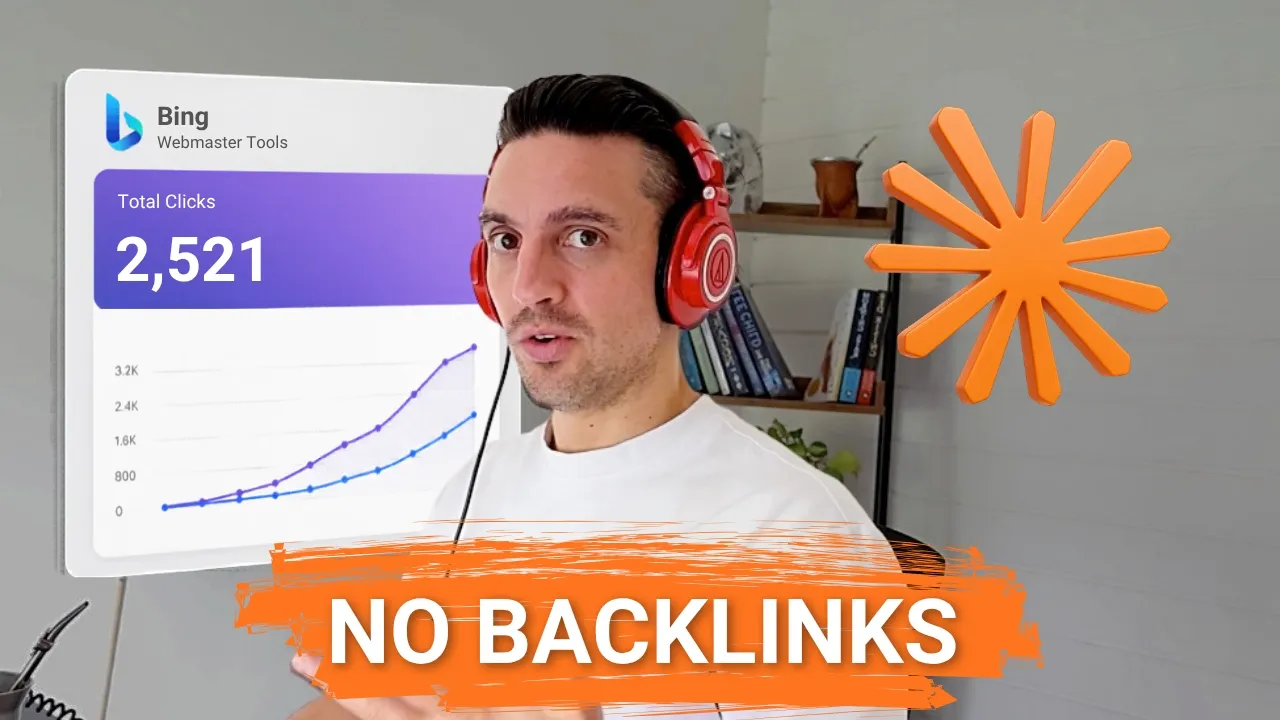
From launch on April 5 to May 11, the site pulled 2,669 sessions, 101 Google Search Console clicks, 2,500+ Bing clicks, and citations across ChatGPT, Perplexity and Copilot. Zero backlinks.
Here is the breakdown that surprised me most:
- Organic search drove the majority of sessions across Google, Bing and Yahoo
- Bing was the biggest traffic source, which matters because AI search traffic converts 4.4x better than traditional organic, and Bing powers Copilot plus a lot of ChatGPT browsing
- Six days in the site was already ranking for 85+ queries
- By week 4 Bing Webmaster Tools AI Performance dashboard was showing real citations inside ChatGPT
The lesson: if you are ignoring Bing Webmaster Tools, you are leaving a huge slice of AI traffic on the table. For some industries, especially desktop-heavy and work-laptop niches, Bing will out-perform Google for months.
Frequently Asked Questions
Do AI-built websites actually rank on Google?
Yes, if the content is genuinely useful and the technical SEO is solid. Google does not penalize AI-generated content as a category, it penalizes thin, unhelpful content. The ranking factors that matter are quality, relevance, structure, and Core Web Vitals, regardless of who or what wrote the page.
Can I really skip backlinks?
For low-competition local niches with weak incumbents, yes, at least for the first 30-90 days. Once you want to compete in saturated head terms, backlinks come back into play, but you can build a meaningful audience and revenue stream long before that point.
Why use Astro instead of WordPress?
Astro outputs static HTML with zero JavaScript by default, so it is faster and cleaner for search engines to crawl. WordPress can get there with the right plugins, but Astro is faster out of the box and pairs natively with Claude Code and Cloudflare for deploys.
How do I get cited by ChatGPT and Perplexity?
Structure your content so each section answers a specific question in the first 40-60 words, then expands. That is the capsule content method, and it is how studies on 8,000+ AI citations found pages get picked up by generative search.
Do I need to know how to code?
No. The entire build in this video was done in plain English. The skill you need is being clear about what you want and verifying that what Claude built actually matches your spec.
Ready to Build Sites That Rank Themselves?
If you want the exact workflow I use, including the capsule content method, the Claude Code SEO setup, and the new 7-day SEO action plan we just released, join the AI Ranking community. Membership also includes unlimited access to Datawise, the SEO tool you saw at the start of the video.
If you have questions about anything in this build, drop them in the YouTube comments. I read every one.
Resources
- Watch the full video on YouTube
- How to Make a Website with Claude & Astro (full tutorial)
- Capsule Content Method
- How to Do SEO for SearchGPT
- SEO in the Age of AI
- Turn Claude 4 Into Your Personal SEO Assistant
- Ahrefs: AI Search Traffic Converts 4.4x Better
- Search Engine Land: Insights From 8,000 AI Citations
- AI Ranking Community
Watch Me Design, Launch and Rank a Website in 30 Min (With Claude)
Four Claude Code systems run my entire SEO workflow under one roof: keyword research, a content writer, a site health audit, and a content refresher. They feed each other like an SEO team would, ship blog posts that follow the capsule content method, and run on a Monday 9am cron. One repo, four prompts, free organic traffic.
Why bother building an SEO system inside Claude Code?
Because most SEO tools force you to bounce between five tabs to ship one blog post, and the boring tasks (the ones that actually move rankings) are the ones you skip. I built four systems that connect under one roof and feed each other like an actual SEO team would. The result on one site was 14.4M impressions and 90,000 organic clicks. Two newer sites started pulling organic traffic the week they launched.
No ads, no agency, no five-tool stack. Just Claude Code running the work.
And this matters more in 2026 than ever, because AI search engines now convert roughly five times better than traditional organic traffic, but only if your content is structured to be cited. These systems are what get you there without burning a weekend.
What are the 4 Claude Code SEO systems?
The four systems are keyword research, a content writer, an on-site audit, and a content refresher. Each one is a skill Claude Code can run on command, and each one outputs into a shared dashboard so the next system knows what the previous one did.
- System 1 — Keyword research: Builds a keyword bank + fan-out cluster + content queue. Run once a month.
- System 2 — Content writer: Drafts ranking-ready blog posts using the capsule method. Run weekly.
- System 3 — On-site audit: Pulls a full health report via DataForSEO. Run fortnightly.
- System 4 — Content refresher: Flags decaying or de-indexed posts to rewrite. Run monthly.
The trick is they share state. The keyword researcher knows what's already been covered, so the content writer can't cannibalise itself. The audit knows which pages exist. The refresher knows which ones are dying.
What do you need before you start?
You need a project folder, Claude Code, and a DataForSEO key. That's it.
- A project folder on your local machine with your business info inside (services, locations, brand voice, USPs)
- Claude Code installed (desktop app or CLI, which I prefer for SEO automations)
- A free DataForSEO account (this link gives you $5 free credit instead of $1, pay-as-you-go after that)
- The GitHub repo with all four systems pre-built: github.com/NicoSKOOL/the-four-systems
Hand Claude Code the repo link and tell it to install the systems for this business. Eight to ten minutes later, all four skills are wired up and pulling your business context. Auto-mode helps here so it stops asking permission every 30 seconds.
If you've never connected Claude Code to MCP servers before, watch my SEO Command Center setup video first, then come back.
How does System 1 (keyword research) work?
You type a service or topic, and Claude Code runs the keyword research skill, builds a fan-out cluster, and saves it to a dashboard.
In my example I ran it for “therapeutic gardening”. A couple of minutes later I had 31 keywords, a CSV file, and a live HTML dashboard. The dashboard has two things that matter:
- A keyword bank of every keyword in the cluster, with status flags so Claude knows which ones it's already targeted (this is what stops content cannibalisation)
- A fan-out cluster of supporting keywords that should appear as H2s or H3s inside the eventual blog post
So by the time System 1 is done, System 2 already knows exactly what to write and which headings to use. You only need to run keyword research once a month, or whenever you run out of content.
This is the same fan-out logic Google's AI uses to decide what to cite, which is why fan-out queries are the unlock for ChatGPT citations too.
How does System 2 (the content writer) write ranking blog posts?
You tell Claude Code “write the next blog post”. It pulls from the keyword bank, drafts a post using the capsule content method, and outputs an MD file or publishes directly to your site.
Specifically, the content writer does six things automatically:
- Injects your experience from the business files (first-person stories, real numbers, anything that smells like E-E-A-T)
- Targets the primary keyword in the title and an H1, and the fan-out keywords in H2s and H3s
- Writes ~70% in the capsule method (H2s phrased as questions, answered in the first one or two sentences)
- Cites high-trust sources like government domains, official health bodies, primary research
- Internally links across the site because it reads your sitemap
- Adds a TL;DR block at the top, which is now best practice for getting cited by AI search
If your site is built on Astro, the post publishes itself to the live site without you ever opening a CMS. If you're on WordPress, you get a clean MD file to paste in, and the WordPress REST API can automate that part too.
Community win: Inside the AI Ranking community, Steven used a version of this exact workflow to index more than 800 local service pages, which generated 105 booked appointments in a single month from organic traffic alone. No ads.
Don't worry about making posts longer. Worry about making them better. The content writer was tuned for citation-readiness, not word count.
How does System 3 (the on-site audit) work?
You run “audit the site”, Claude Code calls DataForSEO, and you get a full health report inside the dashboard with prioritised fixes.
On the test site, it returned an on-page score of 97/100 and an SEO score of 99/100, plus a list of broken links and slow pages to fix. Total DataForSEO cost: about 48 cents. With the $5 free credit, you can run this 10 times before paying anything.
The audit also tells you exactly which fixes to do first. If your site is on Astro and Claude Code can edit it directly, you can tell Claude to fix them for you. If you're on WordPress, you do the fixes manually but at least you know what to fix.
Run this once a fortnight, definitely once a month. Most people skip on-page audits because the data is overwhelming. Claude's job is to do the distilling for you.
How does System 4 (the content refresher) work and why does nobody run it?
The content refresher reads your Google Search Console data, finds blog posts that are decaying or de-indexed, and tells you exactly which ones to rewrite. Almost nobody runs this, and it's the highest-ROI system of the four.
Here's why it matters: only around 60% of the blog posts you publish stay indexed. Google has been getting much stricter about what it keeps in its index, and “crawled, currently not indexed” is Google's passive-aggressive way of saying it read your content and didn't think it was worth keeping.
When you run run refresh recommender, Claude:
- Pulls your Search Console coverage data
- Flags pages that are decaying in rank or dropped from the index
- Tells you whether to rewrite, merge, or kill each one
- Optionally rewrites the page using System 2 so the new draft inherits your business context and the capsule method
This is the half of the job most people skip. Generating new content is only 50% of SEO. The other 50% is keeping the content you already have alive.
How do you put all four systems on a schedule?
You tell Claude Code to turn the workflow into a routine, and it sets it as a local automation.
The simplest version is one sentence:
“Set this workflow to run every Monday at 9:00 AM.”
Claude Code registers it as a routine. If you're using the desktop app, the catch is that your computer has to be on at run time. If you're using the CLI, you can run it as a cron job in headless mode, which is what I do across multiple sites.
If you want this fully cloud-based, you'd need to move the MCP connections (Search Console, DataForSEO) to the cloud too, which is more setup than most people want. Local cron is the 80/20.
And yes, before you ask, this all works in Codex with GPT-5.5 too. Same architecture, different runtime.
Frequently Asked Questions
Do I have to use Astro for this to work?
No. Astro just lets Claude publish posts directly without touching a CMS. WordPress, Webflow, Framer, all work, you just plug into their APIs or paste the MD file manually.
How much does DataForSEO cost to run all four systems?
The on-site audit was 48 cents per run on a small site. Keyword research is a few cents per cluster. Even if you ran the full stack weekly, you'd burn through the free $5 credit in a couple of months.
Can I run this in Codex instead of Claude Code?
Yes. I have a full walkthrough on running the same workflow with Codex and GPT-5.5. The systems are agnostic, the runtime isn't.
What's the capsule content method?
A blog structure where every H2 is a question and the first sentence answers it directly, so AI search engines can lift the answer cleanly. Full breakdown here.
Will the content writer trigger an AI penalty?
No. Google has publicly said AI content is fine when it's helpful. The reason this workflow doesn't trip penalties is the business context injection, the source citations, and the capsule structure. That's what “helpful” looks like.
Want me to set this up for you?
If you'd rather skip the wiring step and learn this inside a community of people running it in production, AI Ranking is where the full workflow lives. Live SEO audits every Thursday, weekly tutorials on systems like these, and a private repo of the agents, skills, and prompts I use across every site.
Resources

I Built 4 Claude Code Systems That Run My Entire SEO Workflow (14.4M Impressions)
Stay Updated with Our Insights
Subscribe to our newsletter for the latest tips and trends in AI-powered SEO.